
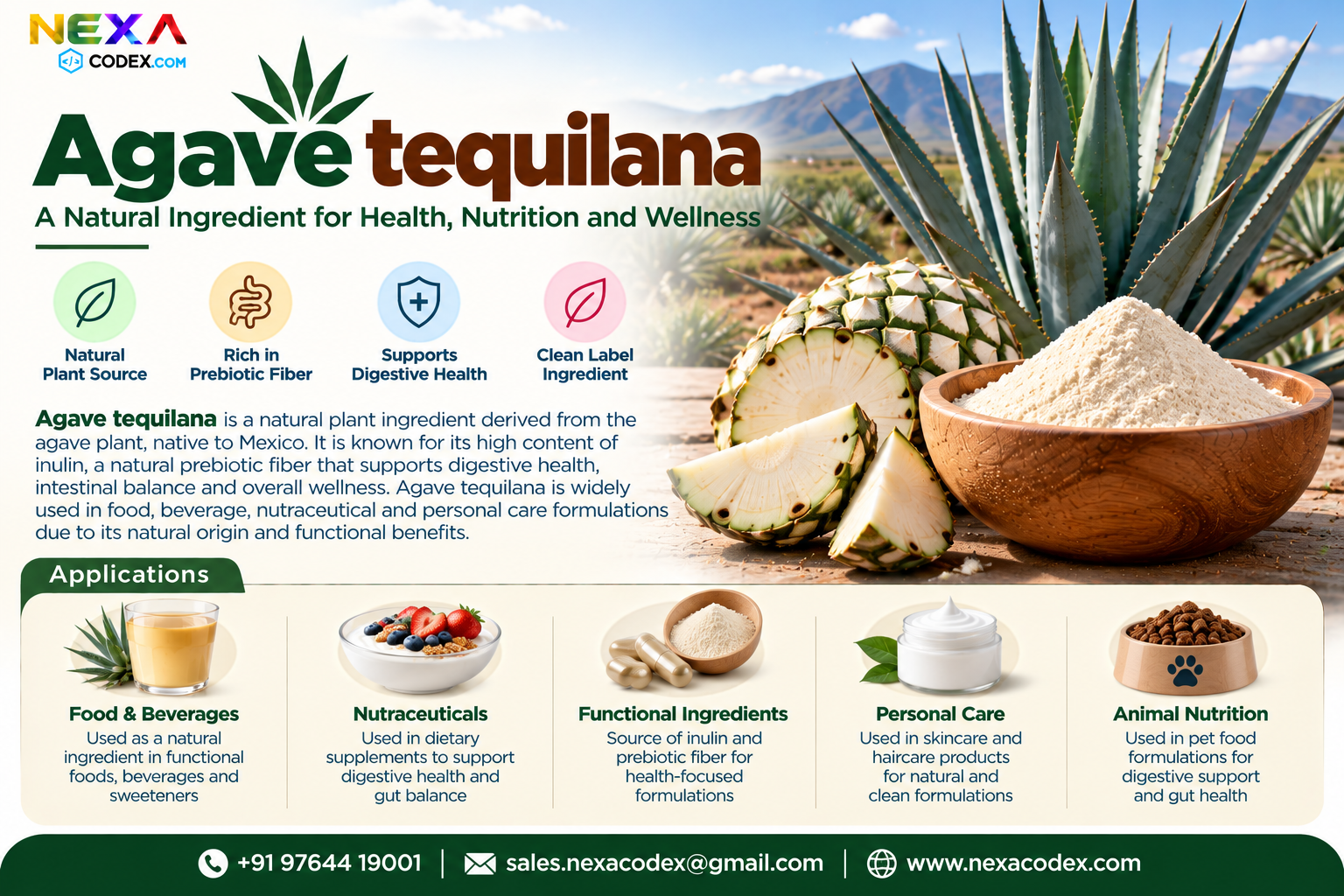
Agave tequilana, commonly known as blue agave or tequila agave, is a succulent plant belonging to the Asparagaceae family. Native to Mexico, this plant is recognized for its thick, fleshy leaves arranged in a rosette pattern and its ability to store water and carbohydrates. Blue agave is particularly well known as the botanical source used in the production of tequila under applicable production regulations.
Agave-derived materials are available in different forms depending on the plant part used and the processing method. These may include agave juice, syrup, concentrated extracts, and other processed ingredients. The properties, composition, and intended applications of each material depend on its grade, processing conditions, and product specifications.
The blue agave plant typically develops a compact rosette of long, rigid, pointed leaves with a blue-green or grey-green appearance. Its leaves have thick tissues adapted to dry environments, while its carbohydrate reserves are stored primarily in the plant's central core, commonly called the piña.
The plant grows over several years before reaching maturity. When mature plants are harvested for tequila production, the leaves are generally removed to expose the central core, which contains carbohydrates that can be processed into fermentable sugars.
The composition of Agave tequilana varies according to the plant's maturity, growing conditions, harvested plant part, and processing method. Agave-derived materials may contain carbohydrates, including fructans and their processed sugars. The carbohydrate profile of the final ingredient depends on whether the material is raw plant tissue, juice, syrup, or a processed extract.
Other naturally occurring constituents may be present in the plant material. However, their concentrations should not be assumed without analytical testing. A product-specific Certificate of Analysis (COA) is recommended to confirm composition, moisture, purity, and other relevant parameters.
Processing methods depend on the intended end product. For tequila production, the harvested central cores undergo approved processing steps to make their carbohydrates available for fermentation. Other agave-derived ingredients may involve extraction, filtration, concentration, or dehydration.
The resulting material can differ considerably in colour, consistency, carbohydrate composition, moisture content, and solubility. Therefore, product documentation should clearly identify the specific form supplied and distinguish whole botanical material from syrup, juice, powder, or concentrated extract.
Agave tequilana is best known for its role in tequila production. Agave-derived ingredients may also be used in other beverage applications where permitted by applicable regulations and where the ingredient meets the relevant product specifications.
Certain processed agave ingredients, particularly agave syrup, may be used as sweetening ingredients in food formulations. Their suitability depends on composition, sweetness profile, processing method, and the requirements of the intended food product.
Agave plant materials may be studied for their carbohydrate composition, botanical characteristics, and potential industrial applications. Research use requires appropriate identification and analytical documentation.
Agave-derived materials may be evaluated for use in ingredient development and formulation projects. Selection should be based on the required carbohydrate profile, physical properties, processing compatibility, and applicable regulatory requirements.
Quality requirements should be established according to the exact form and intended application of the product. Relevant tests may include botanical identity, appearance, moisture content, carbohydrate profile, microbiological quality, and contaminant analysis. For syrup or concentrated extracts, additional parameters may include soluble solids, sugar profile, and other process-specific measurements.
Specifications should be supported by validated analytical methods and a current COA. Values for assay, moisture, impurities, or other parameters should not be assigned until the relevant material has been tested or its approved specification has been reviewed.
Storage requirements depend on the form of the agave-derived material. Dry powders and botanical materials should generally be protected from moisture, contamination, and unsuitable storage conditions. Syrups and liquid extracts should be stored in compatible, sealed containers according to the supplier's instructions.
Always follow the product-specific technical documentation and applicable food-safety or industrial handling requirements.
Agave tequilana plant material, agave syrup, agave juice, and concentrated agave extracts are not interchangeable products. Each may have a different composition, specification, and intended application. Buyers and formulators should confirm the exact material, origin, grade, processing method, and documentation before selecting a product.
Agave tequilana is an important Mexican succulent with established significance in tequila production and broader relevance as a source of agave-derived ingredients. Its applications depend on the form of material produced and the specifications required for the intended use. Accurate botanical identification, appropriate quality testing, and reliable technical documentation are essential for responsible product selection.
| Parameter | Specification |
|---|---|
| Appearance | Green-blue succulent plant |
Mediocon Inc is a GMP-certified API manufacturer and bulk pharmaceutical ingredient supplier based in Aurangabad, Maharashtra, India. We specialise in supplying Agave tequilana Manufacturer in India | Mediocon Inc. and over 1,000 other Active Pharmaceutical Ingredients, excipients, herbal extracts, and nutraceutical ingredients to pharmaceutical manufacturers worldwide.
Our Agave tequilana Manufacturer in India | Mediocon Inc. is manufactured under strict quality management protocols compliant with WHO-GMP, ISO 9001:2015, and major pharmacopoeial standards (IP, BP, USP, EP). Every batch undergoes full analytical testing before release with a Certificate of Analysis.
Export Markets
Quality & Compliance