
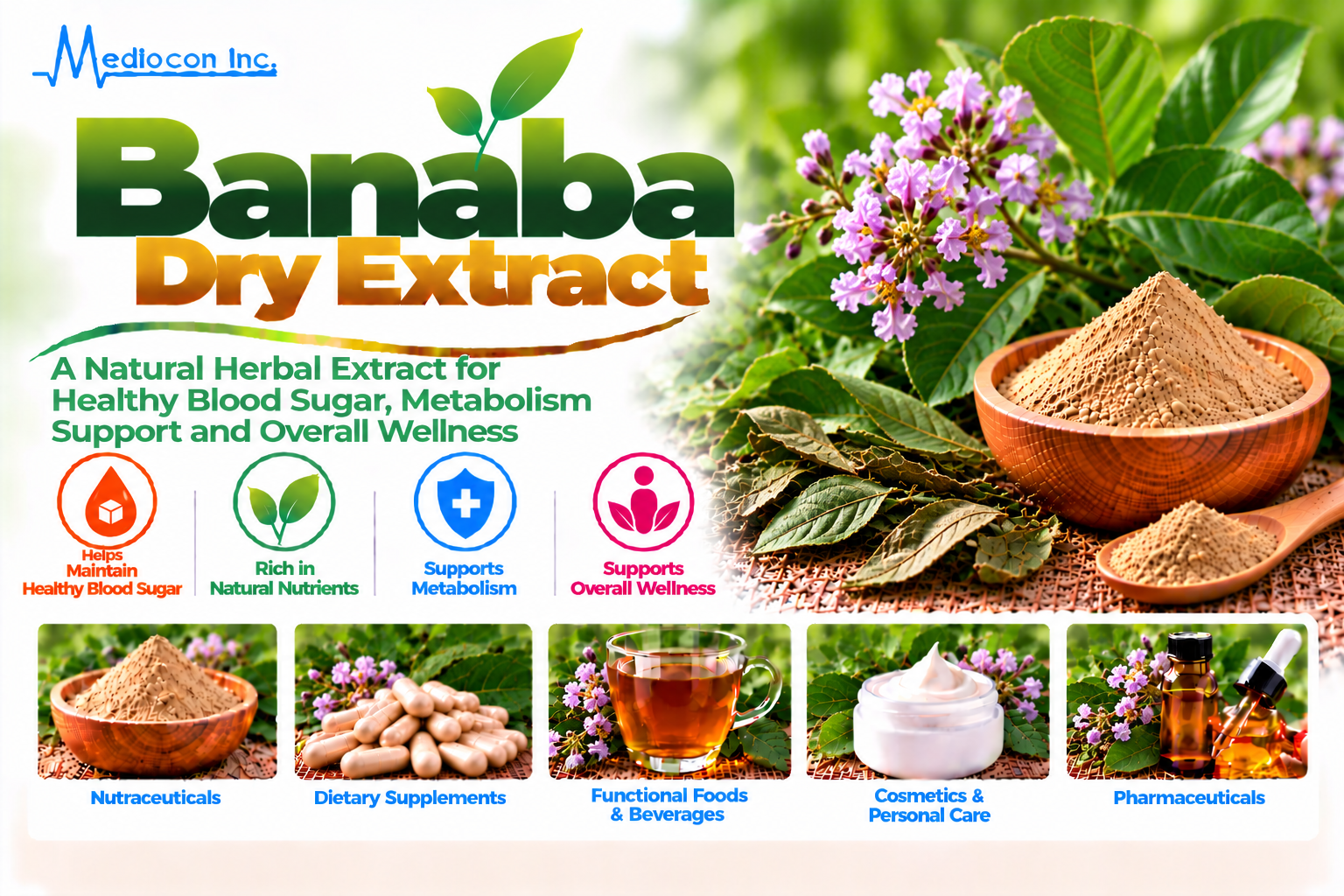
Banaba Dry Extract is a botanical ingredient obtained from Lagerstroemia speciosa, a tropical plant belonging to the Lythraceae family. Banaba is traditionally associated with Southeast Asian botanical practices and has received scientific attention because of its naturally occurring plant constituents, particularly corosolic acid and various polyphenolic compounds.
Banaba leaf extract is commonly investigated in botanical and nutraceutical ingredient research. The chemical composition of the extract depends on the plant part used, the extraction solvent, processing conditions, and any standardization requirements. For this reason, the botanical identity and product specifications are important when evaluating Banaba Dry Extract for commercial applications.
Mediocon Inc. product documentation should identify the exact plant part, extract form, standardization, and quality parameters associated with the available grade. These details help ingredient buyers, researchers, and product developers determine whether the material is suitable for their intended application.
Banaba Dry Extract is a concentrated botanical preparation made by extracting selected constituents from the plant material and converting the extract into a dry form. Leaves are a commonly studied source of Banaba extract, although the plant part used in a particular commercial product must be verified.
The manufacturing process may involve raw material preparation, extraction, filtration, concentration, drying, and quality testing. Depending on the process, the finished ingredient may contain different proportions of naturally occurring compounds.
Commercial extracts may be standardized to a selected marker, such as corosolic acid, or supplied according to other product-specific specifications. Not every Banaba Dry Extract is standardized to the same marker or concentration.
A dry extract should not be assumed to have a particular corosolic acid percentage, extraction ratio, or level of purity unless that information is confirmed by the manufacturer's technical documentation and Certificate of Analysis.
Correct botanical identification is essential for maintaining product authenticity and consistent quality.
Banaba is a tropical tree found in parts of Southeast Asia and other suitable growing regions. The chemical composition of its leaves may vary according to growing conditions, plant maturity, geographical origin, harvesting practices, and post-harvest handling.
The botanical name and plant part should be recorded in purchasing specifications, manufacturing records, and product labeling. This helps distinguish Banaba extract from other botanical ingredients and supports traceability throughout the supply chain.
Banaba has been investigated for a range of naturally occurring plant compounds. Their presence and concentration depend on the plant material and extraction process.
Corosolic acid is a pentacyclic triterpenoid associated with Banaba leaves and is a commonly investigated marker compound in standardized Banaba extracts.
Scientific research has examined corosolic acid in laboratory experiments, animal models, and limited human studies, particularly in relation to glucose and lipid metabolism. However, research findings should not be interpreted as proof that every Banaba extract produces a particular health outcome.
Where a product is standardized to corosolic acid, the specification should state the target concentration and the analytical method used to measure it.
Ellagitannins are a group of polyphenolic compounds investigated in Banaba and other botanical materials. They have been discussed in scientific literature examining the chemical composition and biological activity of Banaba extracts.
The amount recovered depends on the plant material, extraction solvent, and processing conditions. A commercial product should not be assumed to contain a specified amount unless the relevant test results support that claim.
Polyphenols form a broad group of naturally occurring plant constituents. Research on Banaba has examined several phenolic compounds and their potential biological activities under experimental conditions.
Their profile may vary considerably between extracts. Analytical characterization is therefore important when a particular compound or group of compounds is relevant to the intended application.
The manufacturing process depends on the required extract profile and the applicable product specification. A typical process may include the following stages.
The selected plant material should be identified as Lagerstroemia speciosa and checked for authenticity, condition, and suitability. When the product is intended to be a leaf extract, the use of leaves should be confirmed through the raw material documentation.
The raw material may be cleaned and prepared for extraction. Particle size and handling conditions can influence extraction efficiency and the consistency of the resulting material.
The plant material is treated with a suitable extraction medium to recover selected constituents. The solvent system, extraction time, temperature, and other processing conditions affect the composition of the extract.
After extraction, the liquid is separated from the spent plant material and may be filtered and concentrated. Processing parameters should be controlled to help achieve consistent batch characteristics.
The concentrated extract is converted into a dry form using an appropriate drying method. The resulting powder may vary in color, flow properties, moisture content, and solubility according to its composition and manufacturing process.
The finished batch should be evaluated against an approved specification. Relevant tests may include botanical identity, marker assay, moisture, contaminants, and microbiological quality, depending on the intended application.
Packaging and storage conditions should be selected according to the product's stability characteristics.
Banaba Dry Extract may be considered for selected botanical, nutraceutical, and research applications, subject to product quality, safety assessment, and applicable regulations.
Certain Banaba leaf extracts are studied as botanical ingredients for nutraceutical development. The suitability of a particular grade depends on its composition, specification, permitted use, and intended market.
Product developers should evaluate the available technical documentation before incorporating the ingredient into a finished formulation.
Banaba extracts may be used in research examining plant constituents, extraction processes, analytical methods, and the characteristics of standardized botanical preparations.
Research results must be interpreted according to the specific extract tested. Different solvents, plant parts, and standardization levels can produce materials with different chemical profiles.
Standardization is important when a specified compound is used as a marker for quality control. Banaba extracts standardized to corosolic acid may be assessed using suitable analytical methods to confirm consistency with the approved specification.
The marker concentration should be verified for each relevant product grade and batch.
Depending on the grade and regulatory suitability, Banaba Dry Extract may be evaluated during formulation research. Relevant factors include powder handling, dispersibility, solubility, compatibility with other ingredients, stability, and packaging requirements.
Suitability should be established through appropriate testing rather than inferred from the botanical name alone.
Banaba and corosolic acid have attracted scientific interest because of their potential biological activities. Reviews have summarized research involving laboratory studies, animal experiments, and some human investigations.
Much of the research concerns glucose metabolism and related metabolic processes. However, the strength of the evidence varies, and the findings cannot automatically be generalized to all Banaba extracts or commercial formulations.
A laboratory finding does not establish a clinically meaningful benefit in humans. Banaba Dry Extract should not be described as a treatment or cure for diabetes or other medical conditions unless the relevant claims are supported by appropriate evidence and permitted by applicable regulations.
Product marketing should distinguish established product characteristics, such as botanical identity and verified marker content, from preliminary research findings.
Quality requirements should be established according to the product form, intended application, and relevant regulatory standards.
The product should be traceable to Lagerstroemia speciosa. The plant part should be clearly stated in the technical specification.
Where applicable, corosolic acid content may be used as a standardization parameter. The assay method and acceptance range must be confirmed from the actual product specification.
Moisture or loss on drying may be measured to evaluate the physical quality and storage characteristics of the dry extract.
Testing may be required for heavy metals, pesticide residues, microbial contamination, and other relevant contaminants, depending on the intended use and applicable requirements.
Where solvents are used during extraction, residual-solvent testing should be considered according to the process and applicable standards.
Microbiological requirements should be appropriate to the intended application. The relevant limits and test methods should be documented in the approved specification.
Packaging should protect the extract from conditions that could affect its quality. Shelf life and storage instructions should be supported by suitable product documentation and stability information.
Ingredient buyers and product developers should consider several factors before approving a Banaba Dry Extract.
The safety and suitability of a botanical extract depend on its composition, concentration, quality, intended use, and exposure. Evidence relating to one Banaba preparation should not automatically be applied to every commercial extract.
Because Banaba research includes effects related to glucose metabolism, individuals taking glucose-lowering medication should consult a qualified healthcare professional before using Banaba-containing supplements. Potential interactions and individual health circumstances require appropriate professional assessment.
Manufacturers should verify the regulatory status of the ingredient and the finished product in the target market. Medical claims, dosage recommendations, and claims about disease prevention or treatment should not be made without suitable evidence and authorization.
Banaba Dry Extract is a botanical preparation obtained from Lagerstroemia speciosa. Leaves are a commonly studied source, but the plant part for a specific commercial product should be confirmed.
The botanical name is Lagerstroemia speciosa (L.) Pers., a member of the Lythraceae family.
Corosolic acid is a naturally occurring pentacyclic triterpenoid found in Banaba and other plant sources. It is often investigated as a marker compound in standardized Banaba leaf extracts.
No. Standardization depends on the product grade. The marker and its concentration should be verified from the product specification and Certificate of Analysis.
Important factors include botanical identity, plant part, raw material quality, extraction conditions, drying method, marker content where applicable, contaminant testing, and storage.
Testing may include botanical identity, corosolic acid assay where relevant, moisture content, heavy metals, residual solvents, and microbiological quality, depending on the product specification.
Depending on the grade and regulatory suitability, it may be evaluated for botanical research, nutraceutical ingredient development, and selected formulation studies.
Follow the product-specific storage instructions. Packaging should protect the material from moisture and other conditions that could compromise stability.
Buyers should request the technical data sheet, batch-specific Certificate of Analysis, applicable safety documentation, and relevant regulatory or quality documents.
Banaba and corosolic acid have been investigated in metabolic research, but the evidence does not establish that every commercial extract treats or cures diabetes. The ingredient should not replace prescribed treatment.
Banaba Dry Extract, derived from Lagerstroemia speciosa, is a botanical ingredient of interest in phytochemical research and selected ingredient-development applications. Corosolic acid is an important compound studied in Banaba leaves, although its concentration varies between extracts and should be verified for any standardized product.
For manufacturers, researchers, and ingredient buyers, careful assessment of botanical identity, extraction method, standardization, quality testing, traceability, and regulatory suitability is essential. Reviewing the product specification and Certificate of Analysis helps establish whether a particular grade meets the requirements of its intended use.
Mediocon Inc. product information should reflect verified specifications, actual availability, and the documented quality characteristics of the relevant grade.
Mediocon Inc is a GMP-certified API manufacturer and bulk pharmaceutical ingredient supplier based in Aurangabad, Maharashtra, India. We specialise in supplying Banaba Dry Extract (Lagerstroemia speciosa) | Mediocon Inc. and over 1,000 other Active Pharmaceutical Ingredients, excipients, herbal extracts, and nutraceutical ingredients to pharmaceutical manufacturers worldwide.
Our Banaba Dry Extract (Lagerstroemia speciosa) | Mediocon Inc. is manufactured under strict quality management protocols compliant with WHO-GMP, ISO 9001:2015, and major pharmacopoeial standards (IP, BP, USP, EP). Every batch undergoes full analytical testing before release with a Certificate of Analysis.
Export Markets
Quality & Compliance