
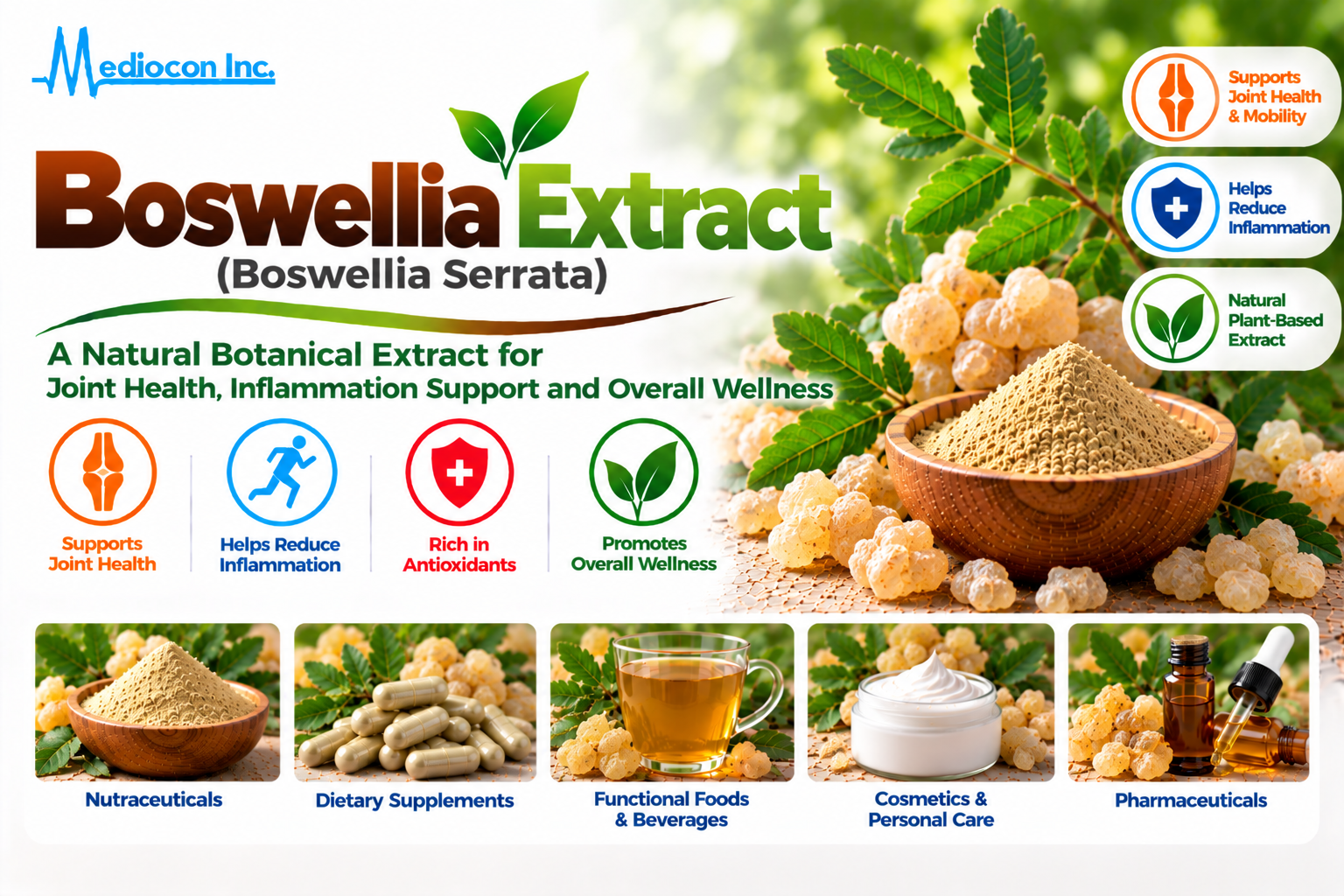
Boswellia Extract is a botanical ingredient obtained from the oleo-gum-resin of Boswellia serrata, a tree belonging to the Burseraceae family. It contains naturally occurring boswellic acids and other resin constituents. Depending on its grade and standardization, the extract may be used in botanical research, nutraceutical development, and other ingredient applications.
Boswellia Extract is derived from the resin of Boswellia serrata, commonly known as Indian frankincense or Salai. The tree has a long history of traditional use, and its resin has attracted scientific interest because of its distinctive chemical composition.
The resin contains boswellic acids, a group of pentacyclic triterpenic acids that are frequently investigated in phytochemical and pharmacological research. The composition of a commercial Boswellia Extract depends on the raw material, extraction solvent, processing conditions, and standardization method.
Boswellia Extract may be available in different grades, including extracts standardized to selected boswellic acid markers. Buyers should confirm the precise grade and assay requirements before selecting an ingredient for a specific formulation.
The oleo-gum-resin is collected from the tree's trunk and branches. Following collection, it may be processed and extracted to produce materials with different compositions and concentrations.
Boswellia resin contains several groups of naturally occurring compounds.
1. Boswellic acids
Boswellic acids are pentacyclic triterpenic acids that serve as important phytochemical markers in many Boswellia extracts. Their concentrations vary according to the raw material and extraction process.
2. Acetyl-11-keto-β-boswellic acid (AKBA)
AKBA is a specific boswellic acid commonly investigated in analytical and pharmacological research. Some standardized extracts specify AKBA content as part of their quality requirements.
3. 11-keto-β-boswellic acid (KBA)
KBA is another compound of interest in Boswellia research. Some product specifications measure KBA together with AKBA to determine a combined marker content.
4. Other resin constituents
Depending on the extraction method, Boswellia materials may contain additional triterpenes, terpenoids, volatile constituents, and other resin-associated compounds.
The presence and concentration of these compounds should be verified through the relevant product specification and analytical report.
Boswellia Extract may be evaluated as an ingredient for nutraceutical development where the relevant grade and local regulations permit its use. Formulators should verify the extract's standardization, intended-use requirements, safety documentation, and suitability for the finished product.
Boswellia Extract is relevant to research examining plant-derived triterpenes, boswellic acid profiles, extraction methods, and analytical characterization. Different extract grades can be compared using validated analytical methods.
The ingredient may be considered for certain herbal formulation projects, subject to the intended product category, quality specifications, safety assessment, and applicable regulations.
Boswellia Extract is also relevant to studies of botanical identity, extract consistency, and marker-compound standardization. HPLC or another suitable validated method may be used to quantify specified boswellic acid markers.
These potential applications do not mean every extract is suitable for every use. Selection should be based on verified composition and the intended application.
Quality assessment is important when purchasing Boswellia Extract for commercial or research use. Depending on the grade, the specification may include:
Analytical results must be interpreted using the method and reporting basis stated in the specification. For example, total boswellic acids, total keto-boswellic acids, and AKBA percentage are not interchangeable measurements.
A batch-specific Certificate of Analysis (CoA) should be reviewed before accepting or publishing any numerical specification.
Store Boswellia Extract according to the instructions supplied for the exact grade. Keep it in suitable packaging and protect it from excessive heat, moisture, and other conditions identified in the technical documentation.
Follow the applicable safety data sheet and handling procedures.
Before selecting an extract, buyers should confirm the botanical source, plant part, extraction process, marker-compound requirements, extract form, and intended application. Product documentation should clearly identify the analytical methods and acceptance criteria used for quality control.
Boswellia Extract (Boswellia serrata) is a botanical ingredient valued for its distinctive resin chemistry and boswellic acid content. Its composition and suitability depend on the extraction process, standardization, quality testing, and intended use.
For businesses evaluating this ingredient, reviewing product-specific specifications and a current CoA is an important step toward informed ingredient selection.
Mediocon Inc is a GMP-certified API manufacturer and bulk pharmaceutical ingredient supplier based in Aurangabad, Maharashtra, India. We specialise in supplying Boswellia Extract (Boswellia serrata) Manufacturer in India | Mediocon Inc. and over 1,000 other Active Pharmaceutical Ingredients, excipients, herbal extracts, and nutraceutical ingredients to pharmaceutical manufacturers worldwide.
Our Boswellia Extract (Boswellia serrata) Manufacturer in India | Mediocon Inc. is manufactured under strict quality management protocols compliant with WHO-GMP, ISO 9001:2015, and major pharmacopoeial standards (IP, BP, USP, EP). Every batch undergoes full analytical testing before release with a Certificate of Analysis.
Export Markets
Quality & Compliance