
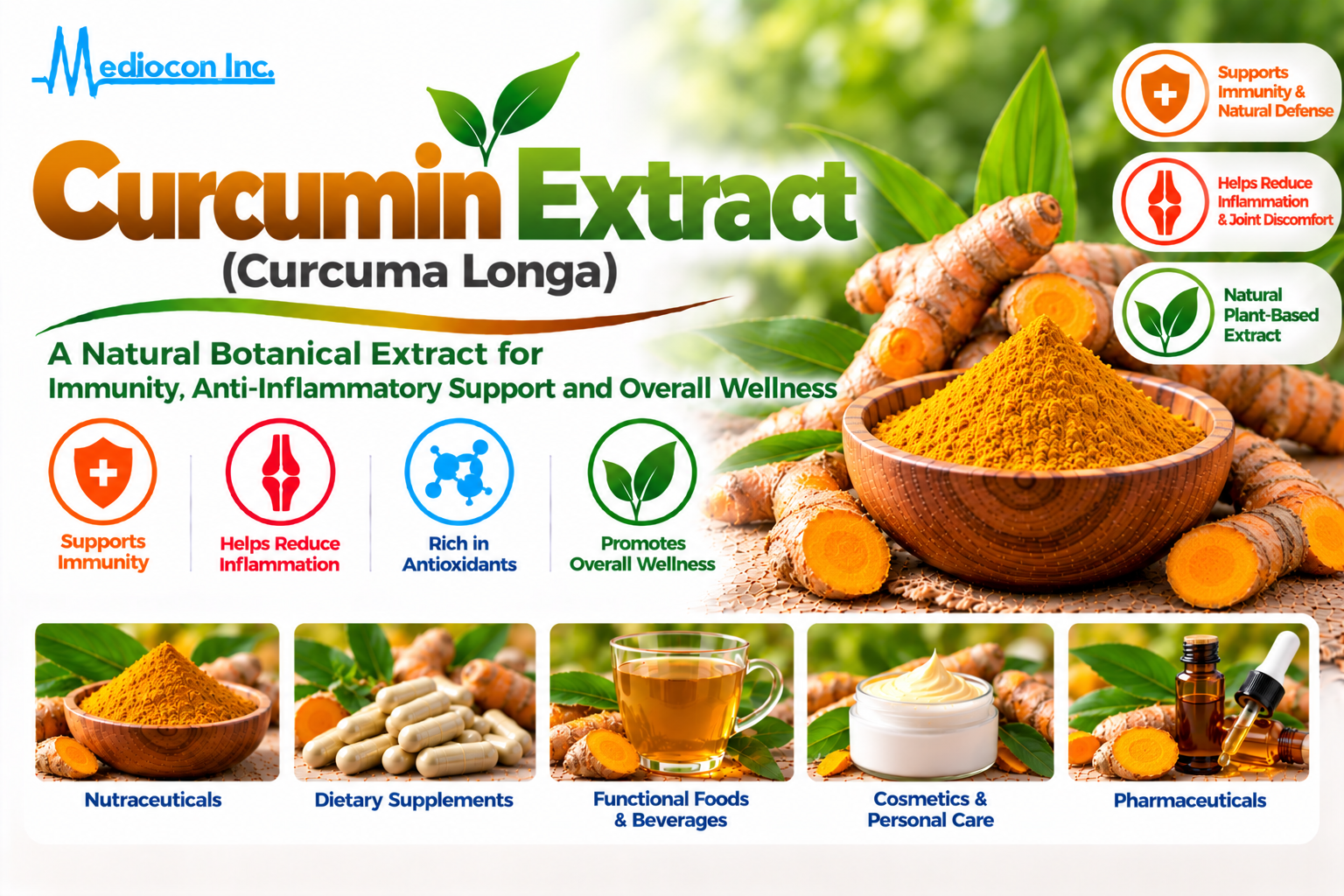
Curcumin Extract is associated with turmeric, a rhizomatous plant widely used as a culinary spice and botanical material. Turmeric rhizomes contain several naturally occurring curcuminoids, including curcumin, demethoxycurcumin, and bisdemethoxycurcumin.
Commercial turmeric extracts differ according to their extraction method, curcuminoid concentration, formulation, and intended application. Some products are standardized to total curcuminoids, while others specify curcumin content separately. These measurements should be clearly distinguished in product documentation.
For buyers and formulation developers, confirming the botanical source, rhizome material, extraction process, curcuminoid assay, and product grade is essential when selecting an appropriate extract.
The turmeric rhizome is processed using suitable extraction techniques to obtain turmeric-derived materials with different compositions. The resulting extract may be further concentrated or standardized according to the intended product specification.
Curcumin is a yellow-orange polyphenolic compound that contributes to turmeric's characteristic colour. It is widely investigated in chemical, food, and botanical research.
Demethoxycurcumin is a related curcuminoid naturally found in turmeric. Its concentration can vary according to the source material and extraction process.
Bisdemethoxycurcumin is another naturally occurring curcuminoid associated with turmeric extracts. It may be included in analytical assessments of total curcuminoid content.
Depending on the extraction process, turmeric-derived materials may contain other plant constituents, including volatile compounds. The actual composition depends on whether the product is a curcuminoid-rich extract, a broader turmeric extract, or a formulated ingredient.
The product's technical specification and CoA should identify which compounds are measured and how the assay is reported.
Selected turmeric-derived extracts may be considered for nutraceutical formulations where permitted by applicable regulations. Product developers should assess the ingredient's composition, formulation requirements, safety documentation, and permitted claims.
Turmeric-derived ingredients may be evaluated for selected food applications, subject to the grade, intended use, applicable food regulations, and relevant stability requirements.
Depending on its quality and compatibility, a turmeric-derived extract may be considered for selected cosmetic formulations. Formulators should evaluate its colour, solubility, stability, compatibility, and suitability for the intended product.
Curcumin and related curcuminoids are widely studied in research involving plant chemistry, analytical characterization, extraction processes, and ingredient standardization.
These potential applications do not establish clinical effectiveness or guarantee suitability for every product. Finished-product claims and uses must be supported by appropriate evidence and regulatory review.
Quality control is essential when sourcing Curcumin Extract. Depending on the product grade, specifications may include:
HPLC or another suitable validated analytical method may be used to measure curcumin and related curcuminoids. The method, reference standard, and reporting basis should be documented.
A current Certificate of Analysis (CoA) should be reviewed before publishing numerical assay values or claims about standardization.
Store Curcumin Extract according to the instructions for the specific product. Appropriate packaging and protection from excessive heat, moisture, and unsuitable environmental conditions can help maintain material quality.
Follow the product-specific technical documentation and applicable safety handling procedures.
When selecting an extract, buyers should confirm whether the product is a turmeric extract or a curcuminoid-standardized extract. They should also verify the plant part, extraction method, curcumin assay, total curcuminoid content, physical properties, and intended application.
A higher stated curcuminoid concentration does not automatically mean a product is suitable for every formulation. Solubility, stability, processing requirements, and the intended use should also be considered.
Curcumin Extract from Curcuma longa is a botanical ingredient valued for its naturally occurring curcuminoids. Its composition and suitability depend on the extraction process, standardization, analytical testing, and intended application.
For informed ingredient selection, review the botanical identity, product specification, and batch-specific CoA before making purchasing or formulation decisions.
| Parameter | Specification |
|---|---|
| Identification | Curcuma longa L |
Mediocon Inc is a GMP-certified API manufacturer and bulk pharmaceutical ingredient supplier based in Aurangabad, Maharashtra, India. We specialise in supplying Curcumin Extract (Curcuma longa) Manufacturer in India | Mediocon Inc. and over 1,000 other Active Pharmaceutical Ingredients, excipients, herbal extracts, and nutraceutical ingredients to pharmaceutical manufacturers worldwide.
Our Curcumin Extract (Curcuma longa) Manufacturer in India | Mediocon Inc. is manufactured under strict quality management protocols compliant with WHO-GMP, ISO 9001:2015, and major pharmacopoeial standards (IP, BP, USP, EP). Every batch undergoes full analytical testing before release with a Certificate of Analysis.
Export Markets
Quality & Compliance