
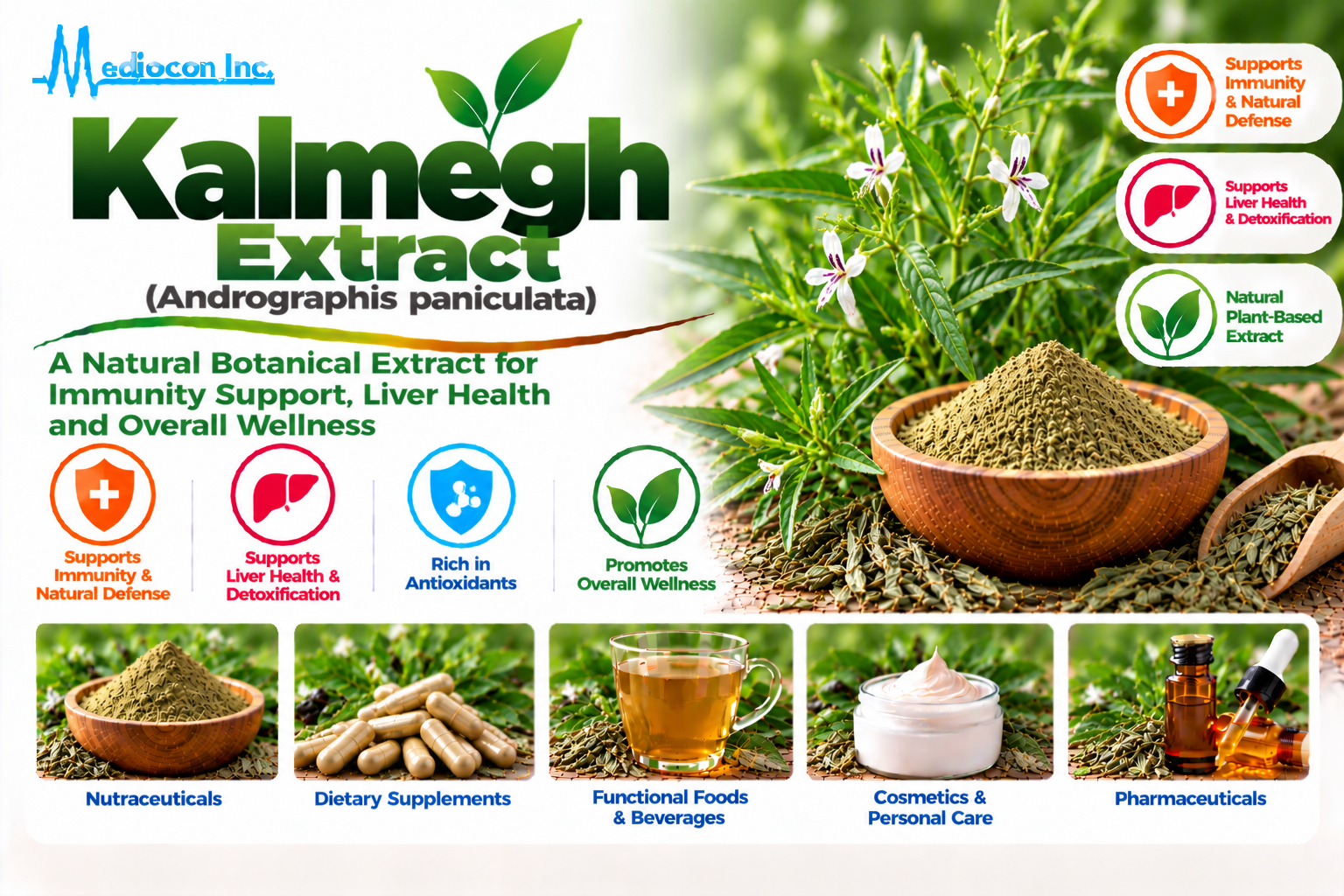
Kalmegh, scientifically known as Andrographis paniculata, is an annual herb belonging to the Acanthaceae family. It is widely recognized in India and several other Asian countries for its traditional use in herbal preparations. Commonly called the King of Bitters, Kalmegh is characterized by its intensely bitter taste and its naturally occurring plant compounds.
Kalmegh has attracted interest from the herbal, nutraceutical, botanical ingredient, and research industries because of its distinctive phytochemical composition. The plant contains several diterpene lactones, including andrographolide, which is one of the most widely studied chemical constituents associated with this botanical species.
Kalmegh is available in different commercial forms, including dried plant material, powdered herb, and concentrated botanical extracts. These forms can differ in their composition, extraction method, concentration, and intended applications. For this reason, the botanical identity, plant part, extraction process, and chemical profile should be established before a product is selected for commercial or formulation use.
Andrographis paniculata is a herbaceous plant native to parts of South Asia and widely distributed across tropical and subtropical regions of Asia. It is known by several common names, including Kalmegh, green chiretta, and King of Bitters.
The plant generally has an upright growth habit, branching stems, green leaves, small flowers, and narrow fruit capsules. Its leaves and aerial parts are commonly used in traditional botanical preparations, although the plant part used in a commercial extract depends on the manufacturer's specification.
The chemical composition of Andrographis paniculata can vary according to growing conditions, plant maturity, geographical origin, harvesting practices, drying, storage, and extraction procedures. Such variation makes botanical identification and analytical quality control important considerations for commercial ingredient sourcing.
For product development, the botanical name should be clearly stated on the product specification sheet. Where applicable, the plant part and extraction ratio should also be documented to distinguish one commercial grade from another.
Kalmegh Extract is a botanical preparation obtained by processing selected parts of Andrographis paniculata. The extraction process is designed to obtain a concentrated preparation containing plant-derived constituents.
Unlike ordinary dried Kalmegh powder, an extract may have a different concentration of selected compounds depending on the extraction solvent, processing conditions, concentration steps, and any standardization applied by the manufacturer.
Some commercial grades are standardized for andrographolide, while others are characterized by a broader botanical profile or supplied according to a particular application requirement. Standardization indicates that a specified chemical constituent or group of constituents is measured against a defined target or acceptance range.
The name Kalmegh Extract alone does not establish a specific andrographolide percentage. For example, extracts marketed at different assay levels should not be considered interchangeable without reviewing their specifications, analytical results, and intended applications.
A reliable product description should therefore identify the botanical source and clearly distinguish verified product characteristics from general information about the plant.
Andrographolide is a naturally occurring diterpene lactone found in Andrographis paniculata. It is an important phytochemical marker used in research and in the quality assessment of certain Kalmegh raw materials and extracts.
Researchers have investigated andrographolide and other constituents of this plant for their biological properties. However, findings from laboratory studies, animal research, and clinical investigations are not equivalent, and evidence for a particular extract cannot automatically be applied to every commercial product.
The concentration of andrographolide depends on the plant material, extraction method, and standardization process. Analytical techniques such as high-performance liquid chromatography (HPLC) and high-performance thin-layer chromatography (HPTLC) can be used to identify and quantify this compound when suitable validated methods are applied.
For commercial applications, the assay result should be supported by appropriate analytical documentation. A product's advertised concentration should not be treated as verified unless the specification and batch-specific Certificate of Analysis (COA) substantiate it.
Kalmegh Extract has several characteristics relevant to botanical ingredient sourcing, product development, and quality assurance.
The botanical source is Andrographis paniculata. Confirmation of the species helps distinguish the intended ingredient from other plants with similar common names.
Kalmegh is traditionally recognized for its pronounced bitterness. The sensory characteristics of a commercial extract can depend on its concentration, plant material, and manufacturing process.
Andrographolide may be used as a chemical marker for specified extract grades. The required assay should be selected according to the intended application and verified through appropriate testing.
The plant part used and the extraction method can affect the composition of the finished ingredient. Buyers should confirm whether the product is derived from leaves, aerial parts, or another specified portion of the plant.
Commercial Kalmegh ingredients may be supplied as dried herb, powder, or concentrated extract. Appearance, moisture content, bulk properties, and solubility should be confirmed for the actual grade.
Quality evaluation may include botanical identification, assay testing, moisture or loss on drying, microbial limits, heavy metals, pesticide residues, and residual solvents, depending on the product and its intended use.
Kalmegh Extract may be considered for a range of botanical and research applications. Its suitability depends on the ingredient specification, evidence supporting the intended use, and applicable regulatory requirements.
Selected Kalmegh extracts may be used in botanical ingredient blends and nutraceutical formulations. Formulators should consider the extract's chemical profile, intended serving level, compatibility with other ingredients, and product-specific safety requirements.
When a formulation requires a standardized ingredient, the andrographolide content should be verified using appropriate analytical methods. The ingredient's quality documentation should support the intended formulation requirements.
Kalmegh has a history of traditional use in herbal systems. Its botanical material and extracts may be incorporated into preparations developed according to the relevant quality, safety, and regulatory standards.
Traditional use should be distinguished from evidence demonstrating the effectiveness of a particular commercial extract for a specific condition.
Certain Kalmegh extracts may be considered during the development of dietary supplements, subject to the regulatory status and suitability of the ingredient in the intended market.
Product developers should evaluate ingredient identity, chemical standardization, potential interactions, labelling requirements, and the quality of supporting documentation before approving a grade for use.
Kalmegh is of interest in phytochemical research because it contains andrographolide and other naturally occurring compounds. Researchers may investigate its chemical composition, extraction procedures, analytical methods, stability, and biological properties.
Research materials should be appropriately characterized so that experimental findings can be interpreted in relation to the actual material tested.
Kalmegh extracts may also be assessed during formulation studies involving botanical blends, physical stability, ingredient compatibility, and analytical characterization. Such work should use documented test materials and suitable methods to ensure reliable results.
Selecting a suitable Kalmegh ingredient requires careful evaluation of its identity, composition, and intended application.
Confirm the scientific name Andrographis paniculata and the plant part used. Botanical authentication supports ingredient identity and helps reduce the risk of substitution or adulteration.
If the formulation requires a standardized extract, confirm the target assay and analytical method. Do not infer a specific percentage from the product name alone.
The extraction ratio may describe the amount of starting plant material used relative to the resulting extract. However, the ratio does not independently establish the andrographolide concentration, purity, or equivalence between products.
Review the approved specifications for appearance, moisture, identification, assay, and other applicable parameters. Numerical limits should be based on the actual commercial grade and its quality documentation.
Depending on the application and regulatory requirements, relevant tests may include heavy metals, pesticide residues, microbial contamination, and residual solvents.
A batch-specific COA allows the buyer to compare actual test results with the approved specification. Traceability records and supporting technical documents also assist with supplier qualification and quality management.
The regulatory requirements for a botanical ingredient can differ by country and product category. Verify that the selected grade is suitable for its intended use and market.
Quality control helps establish the identity, consistency, and suitability of Kalmegh ingredients. Botanical raw materials can vary naturally, so testing requirements should be defined for the specific product and application.
Common quality evaluation parameters may include:
Not every test is applicable to every grade. The final quality specification should be based on the manufacturing process, the product's intended use, and the relevant regulatory requirements.
A batch-specific Certificate of Analysis should document the results for the parameters required by the approved specification. Where an assay is reported, the analytical method and reporting basis should be clear.
Proper storage is important for preserving the quality of botanical ingredients. The recommended conditions for Kalmegh Extract depend on the physical form, packaging, chemical profile, and stability characteristics of the particular grade.
As general precautions, store the product in its original, tightly sealed container and protect it from excessive moisture, heat, and light where specified by the manufacturer. Avoid contamination during sampling and handling, and reseal the container after use.
For commercial formulation, assess the ingredient's compatibility with other materials and its stability under expected manufacturing, packaging, and storage conditions. Shelf life should be supported by suitable product-specific stability data rather than assumed from the botanical source.
The safety profile of Kalmegh Extract depends on the material's composition, concentration, intended use, and exposure level. A concentrated botanical extract may not be equivalent to the whole plant or a traditional preparation.
Andrographis-containing products have been associated with allergic reactions, including reports of serious hypersensitivity reactions. Appropriate caution is therefore important when evaluating concentrated ingredients and finished products.
People taking medicines, those with known plant allergies, and individuals who are pregnant or breastfeeding should seek qualified medical advice before using products containing concentrated Kalmegh extracts. Product developers should conduct an appropriate safety and interaction assessment for their intended use.
Manufacturers and formulators should verify the applicable requirements for ingredient quality, product category, labelling, and health claims in each target market. The presence of a traditionally used botanical compound does not by itself establish the safety or effectiveness of every formulation.
Kalmegh is the common Indian name for Andrographis paniculata, a bitter-tasting herb belonging to the Acanthaceae family.
The botanical name is Andrographis paniculata. The plant is also known as green chiretta and King of Bitters.
Andrographolide is a naturally occurring diterpene lactone and an important chemical marker used in the analysis and standardization of certain Kalmegh ingredients.
No. Commercial products differ in their extraction methods and specifications. The andrographolide content should be confirmed using the product specification and appropriate analytical documentation.
The plant part varies by product. Leaves and aerial parts are commonly used, but the exact source should be confirmed from the manufacturer's documentation.
Depending on the grade and regulatory status, Kalmegh ingredients may be considered for selected herbal, nutraceutical, dietary supplement, and research applications.
Buyers should review the product specification sheet, batch-specific COA, and relevant safety, analytical, traceability, and regulatory documentation.
Follow the manufacturer's recommended storage conditions. Keep the product properly sealed and protect it from conditions that may compromise its quality.
Kalmegh (Andrographis paniculata) is a botanical ingredient recognized for its bitter characteristics and distinctive phytochemical composition. Andrographolide is one of its important chemical constituents and serves as a marker for the quality evaluation of certain raw materials and standardized extracts.
The suitability of Kalmegh Extract depends on its botanical identity, plant part, extraction process, chemical profile, quality controls, and intended application. Reviewing the approved specification, batch-specific COA, and relevant safety documentation helps buyers and product developers evaluate the ingredient more reliably.
For commercial ingredient sourcing and formulation development, product-specific analytical evidence and regulatory review are essential. These steps help ensure that the selected Kalmegh ingredient meets the technical requirements of its intended application.
| Parameter | Specification |
|---|---|
| Identification | Andrographis paniculata |
Mediocon Inc is a GMP-certified API manufacturer and bulk pharmaceutical ingredient supplier based in Aurangabad, Maharashtra, India. We specialise in supplying Kalmegh (Andrographis paniculata) Manufacturer in India | Mediocon Inc. and over 1,000 other Active Pharmaceutical Ingredients, excipients, herbal extracts, and nutraceutical ingredients to pharmaceutical manufacturers worldwide.
Our Kalmegh (Andrographis paniculata) Manufacturer in India | Mediocon Inc. is manufactured under strict quality management protocols compliant with WHO-GMP, ISO 9001:2015, and major pharmacopoeial standards (IP, BP, USP, EP). Every batch undergoes full analytical testing before release with a Certificate of Analysis.
Export Markets
Quality & Compliance