
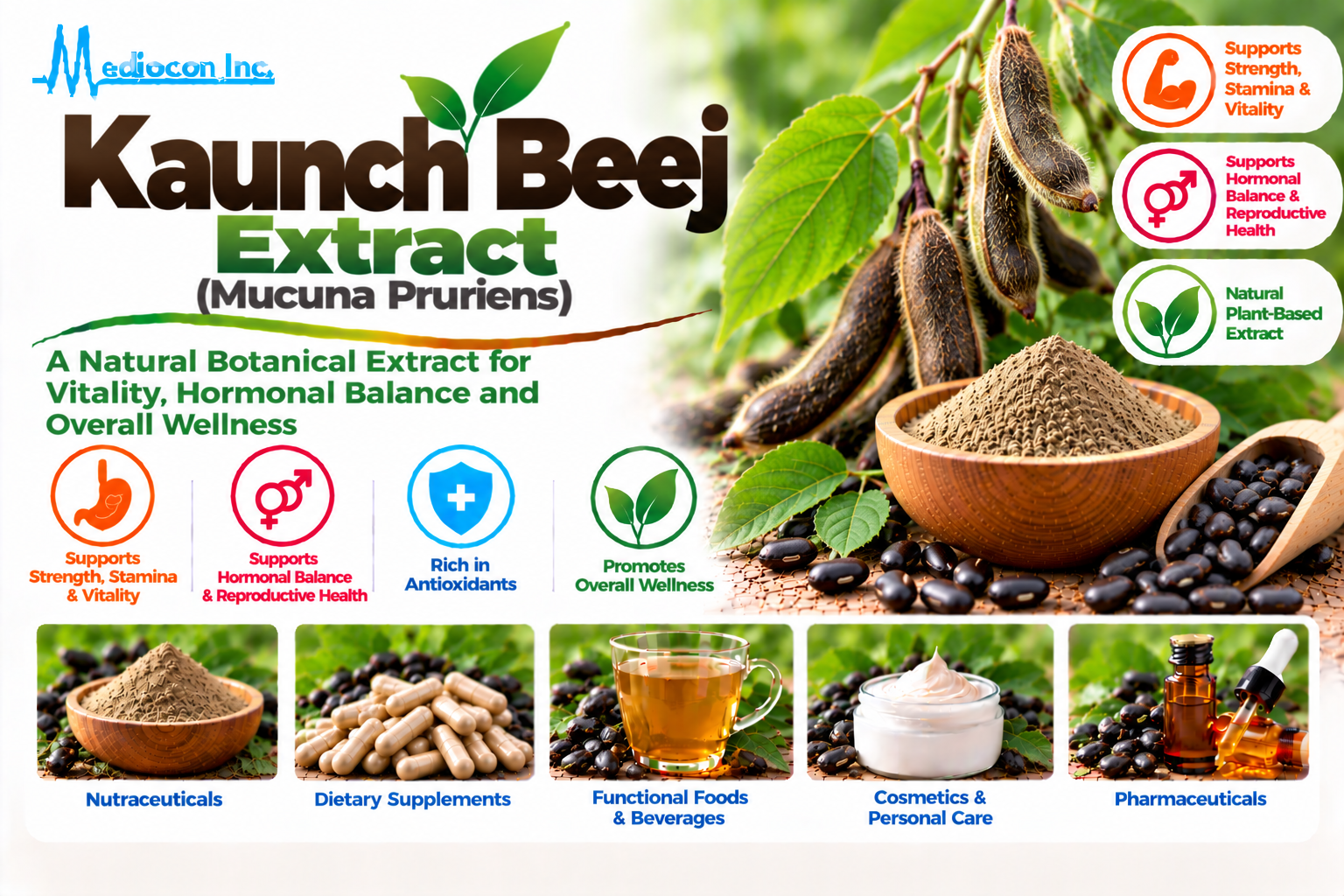
Kaunch Beej Extract is a botanical ingredient derived from the seeds of Mucuna pruriens, a tropical leguminous plant commonly known as velvet bean, cowhage, or Kapikacchu. The plant belongs to the Fabaceae family and has a long history of traditional use in South Asian herbal systems. Its seeds are of particular interest because they naturally contain L-DOPA (levodopa), a compound that is also found in certain other plant species.
Kaunch Beej is used in traditional botanical preparations and has attracted attention from the herbal ingredient, nutraceutical, and research industries. Its chemical composition makes it different from many other botanical extracts, particularly when the product is standardized for L-DOPA.
Commercial Kaunch Beej Extract can vary considerably depending on the seed source, extraction process, processing conditions, and standardization level. Some preparations are characterized by their L-DOPA content, while others may be described according to their general botanical profile.
For commercial sourcing and formulation development, it is important to establish the botanical identity, seed origin, L-DOPA concentration, analytical methods, and product-specific quality specifications before selecting an extract.
Mucuna pruriens is a tropical climbing legume native to tropical regions and cultivated in several parts of the world. It belongs to the Fabaceae family, which includes beans, peas, and other legumes.
The plant produces long pods containing seeds. Some varieties have irritating hairs on their pods, which is why the plant is also known as cowhage or velvet bean. The seeds are the principal source material for many commercial Kaunch Beej ingredients.
Different parts of Mucuna pruriens may contain different chemical constituents. Consequently, a seed extract should not be considered equivalent to an extract made from the leaves, roots, or other plant parts.
The composition of the seeds may vary with plant variety, growing conditions, maturity, harvest practices, storage, and processing. Commercial products should therefore be identified by their botanical name and plant part, with suitable documentation to establish their identity.
Kaunch Beej Extract is a botanical preparation produced by processing the seeds of Mucuna pruriens. The manufacturing process may involve extraction, concentration, drying, and other operations designed to obtain a material with defined characteristics.
Unlike ordinary seed powder, a concentrated extract can contain different proportions of selected constituents. Its chemical profile depends on the raw material, extraction solvent, processing conditions, and any standardization applied by the manufacturer.
One of the most important characteristics of certain Kaunch Beej extracts is their L-DOPA content. L-DOPA is a naturally occurring precursor of dopamine and is the principal compound used to characterize many commercially standardized Mucuna seed extracts.
Not every Kaunch Beej product has the same L-DOPA concentration. Different grades may have different assay specifications and intended applications. Therefore, the product name alone does not establish a particular percentage, extraction ratio, or potency.
For reliable ingredient selection, review the approved product specification and batch-specific Certificate of Analysis (COA), particularly when the L-DOPA content is important to the intended application.
L-DOPA, also known as levodopa or 3,4-dihydroxy-L-phenylalanine, is a naturally occurring amino acid derivative found in the seeds of Mucuna pruriens. It is a precursor of dopamine, a neurotransmitter involved in several functions of the nervous system.
L-DOPA is a pharmacologically active compound. This makes its presence in Kaunch Beej Extract an important consideration for product characterization, safety assessment, and regulatory compliance.
The concentration of L-DOPA varies among seed materials and commercial extracts. Where an extract is standardized for L-DOPA, the specified assay should be confirmed using an appropriate validated analytical method, such as a suitable chromatographic technique.
L-DOPA-containing extracts should not be treated as ordinary, interchangeable botanical ingredients. Their suitability depends on the concentration, intended use, user population, and applicable regulatory requirements.
Kaunch Beej Extract is derived from the seeds of Mucuna pruriens. Confirming the botanical species and plant part is essential for accurate ingredient identification.
L-DOPA is a characteristic constituent of many Mucuna seed extracts. Its concentration depends on the raw material and manufacturing process and should be verified through analytical documentation.
Commercial ingredients may be supplied as seed powder or concentrated extract. These forms can differ in composition and should be distinguished in the product specification.
Certain commercial grades are standardized for L-DOPA. A standardized value should be reported only when supported by a defined specification and suitable analytical results.
Quality evaluation may include botanical identity, L-DOPA assay, moisture content, microbial quality, heavy metals, pesticide residues, and residual solvents, depending on the manufacturing process and intended application.
A grade suitable for research or a particular botanical formulation may not automatically be suitable for a food, supplement, or medicinal product. The intended use and regulatory status should be verified before selection.
Kaunch Beej Extract is relevant to botanical ingredient research and selected product-development activities. Its suitability for any particular application depends on the L-DOPA concentration, product grade, safety assessment, and applicable regulations.
Mucuna seed extracts are used in research involving plant chemistry, L-DOPA analysis, extraction techniques, and botanical characterization. Researchers should document the plant part, extract composition, and analytical method to ensure that the material is properly identified.
Kaunch Beej has a history of use in traditional herbal systems. However, traditional use should not be interpreted as proof that every concentrated extract is safe or effective for a particular condition.
Product developers must evaluate the exact extract, its active-compound content, the intended population, and relevant safety information before considering it for a finished product.
Some developers investigate Mucuna-derived ingredients for specialized botanical formulations. Because L-DOPA is pharmacologically active, its presence requires particular care when assessing intended use, dosage, potential interactions, and regulatory status.
A general description of a botanical ingredient should not be used to imply that an unverified extract is suitable for unrestricted use in dietary supplements.
Kaunch Beej Extract may be used in analytical research and formulation studies to evaluate chemical composition, ingredient compatibility, stability, and assay methods. Such work should use appropriately characterized materials with documented L-DOPA levels.
Confirm the scientific name Mucuna pruriens and verify that the ingredient is derived from the seeds. Botanical identification supports product authenticity and traceability.
If the product specification includes L-DOPA, confirm the required assay, the analytical method, and the acceptance criteria. Never assume a percentage based solely on the product name.
Review the extraction method and any stated extract ratio. An extraction ratio alone does not establish L-DOPA concentration, purity, or equivalence between two commercial grades.
Depending on the intended use, appropriate tests may include heavy metals, pesticide residues, microbial contamination, and residual solvents. Testing requirements should reflect the product's manufacturing process and regulatory context.
Request the product specification, batch-specific COA, and relevant safety and technical documentation. These records help establish whether the actual material meets the approved acceptance criteria.
Because L-DOPA is pharmacologically active, assess the ingredient's legal status and safety requirements in the target market. Do not assume that every Mucuna extract is suitable for general food or supplement use.
Quality control is important for establishing the identity, consistency, and suitability of Kaunch Beej Extract. Botanical materials can vary naturally, and concentrated extracts may differ significantly in their chemical composition.
Depending on the product and its intended use, quality evaluation may include:
Not every test applies to every commercial grade. The final specification should reflect the actual material, extraction process, intended use, and regulatory requirements.
A batch-specific COA should document the results for the required parameters. Reported L-DOPA values should be supported by analytical evidence and should not be copied from unrelated product grades.
Storage requirements for Kaunch Beej Extract depend on its physical form, packaging, chemical composition, and stability characteristics.
As a general precaution, keep the material in its original, properly sealed container and follow the manufacturer's instructions for temperature, humidity, and light exposure. Prevent contamination during sampling and handling and reseal the container after use.
For formulation development, evaluate the stability of the extract under the expected processing, packaging, and storage conditions. Shelf life should be supported by appropriate product-specific data rather than assumed from the botanical source alone.
Kaunch Beej Extract requires careful safety assessment because certain grades contain L-DOPA, a pharmacologically active compound. Concentrated extracts are not necessarily equivalent to traditional preparations or ordinary food ingredients.
L-DOPA can interact with medicines and may cause adverse effects. Individuals taking levodopa, medicines affecting dopamine, or other prescription medicines should not use concentrated Mucuna products without advice from a qualified healthcare professional. People with existing medical conditions, and those who are pregnant or breastfeeding, should seek appropriate medical advice before using concentrated preparations.
Product developers should assess ingredient identity, L-DOPA content, interactions, target population, intended use, and regulatory requirements before approving an extract for a finished product.
Traditional use or the presence of a naturally occurring compound does not establish that every commercial extract is safe or effective for a particular medical condition.
Kaunch Beej Extract is a botanical preparation derived from the seeds of Mucuna pruriens, commonly known as velvet bean or Kapikacchu.
The botanical name is Mucuna pruriens. The plant belongs to the Fabaceae family.
L-DOPA, also known as levodopa, is a naturally occurring compound found in Mucuna seeds. It is a precursor of dopamine and is pharmacologically active.
No. Commercial products vary in composition and standardization. The L-DOPA concentration should be confirmed through the approved product specification and appropriate analytical testing.
Buyers should review the product specification, batch-specific COA, and relevant analytical, safety, traceability, and regulatory documents.
Follow the manufacturer's storage instructions for the specific grade. Keep the product sealed and protect it from conditions that may compromise its quality.
Kaunch Beej Extract (Mucuna pruriens) is a botanical ingredient derived from velvet bean seeds. Its most distinctive characteristic is the presence of naturally occurring L-DOPA, a pharmacologically active compound whose concentration varies between raw materials and commercial extracts.
For commercial sourcing and product development, botanical authentication, L-DOPA standardization where applicable, analytical quality control, batch traceability, and safety assessment are essential. The exact extract specification and intended application should guide ingredient selection.
Reviewing the approved product specification, batch-specific COA, and relevant regulatory and safety documentation helps buyers and formulation specialists determine whether a particular Kaunch Beej Extract meets the requirements of its intended use.
Mediocon Inc is a GMP-certified API manufacturer and bulk pharmaceutical ingredient supplier based in Aurangabad, Maharashtra, India. We specialise in supplying Kaunch Beej Extract (Mucuna pruriens) Manufacturer in India | Mediocon Inc. and over 1,000 other Active Pharmaceutical Ingredients, excipients, herbal extracts, and nutraceutical ingredients to pharmaceutical manufacturers worldwide.
Our Kaunch Beej Extract (Mucuna pruriens) Manufacturer in India | Mediocon Inc. is manufactured under strict quality management protocols compliant with WHO-GMP, ISO 9001:2015, and major pharmacopoeial standards (IP, BP, USP, EP). Every batch undergoes full analytical testing before release with a Certificate of Analysis.
Export Markets
Quality & Compliance