
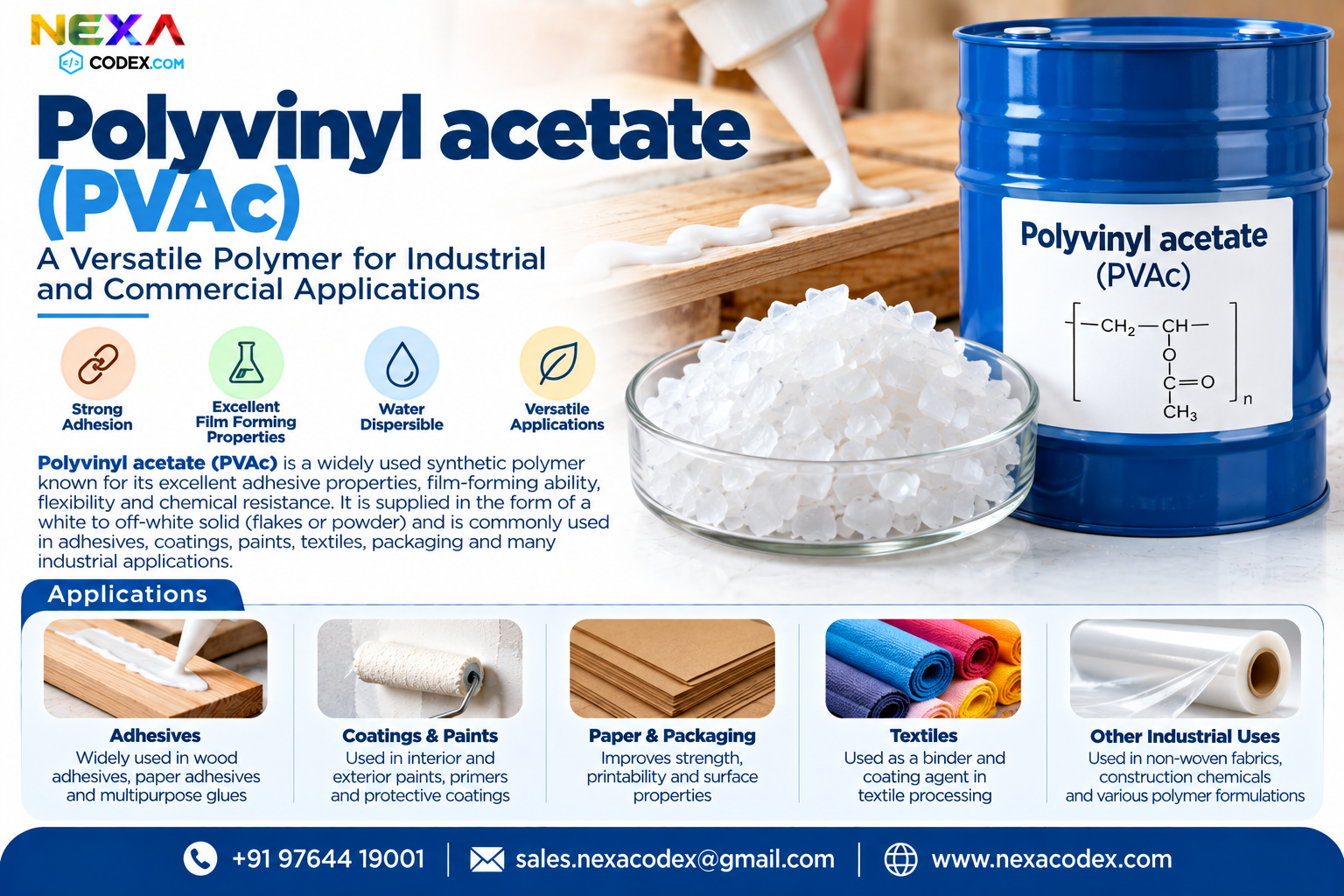
Polyvinyl Acetate (PVAc) is a synthetic polymer produced through the polymerization of vinyl acetate monomer. It is valued for its film-forming properties, adhesion, flexibility, and compatibility with a range of industrial formulations. Commercial PVAc is available in different forms, including solid resin, beads, powders, and aqueous emulsions, depending on the grade and manufacturing process.
PVAc is a polymer, so its molecular weight and physical properties depend on the degree of polymerization and commercial grade.
Polyvinyl acetate is commonly supplied as a colourless or translucent solid resin, beads, or a white-to-off-white aqueous emulsion. The exact appearance depends on the supplied form and formulation. Solid PVAc resin is generally insoluble in water, while commercial emulsions disperse the polymer in water with the help of formulation ingredients.
Its performance depends on factors such as molecular weight, solids content, viscosity, particle size, and any copolymers or additives present in the grade.
PVAc is widely used in water-based adhesives for wood, paper, cardboard, bookbinding, packaging, and other porous materials. It forms an adhesive film as water leaves the emulsion and the polymer particles consolidate.
PVAc-based emulsions are used as binders in selected water-based paints, coatings, and related products. The final performance depends on the formulation and intended application.
PVAc is used in paper coatings, paperboard applications, labels, laminating products, and packaging adhesives where suitable adhesion and film formation are required.
Selected PVAc grades serve as binders in textile finishing, fibre treatment, and nonwoven products.
PVAc may be used in selected sealants, fillers, cement-related formulations, and other industrial products, subject to the requirements of the particular application.
Store Polyvinyl Acetate according to the supplier's technical data sheet and safety data sheet. Keep containers properly closed and protect the material from contamination and unsuitable temperature conditions. For aqueous emulsions, prevent freezing if the product documentation specifies freeze sensitivity.
Use appropriate personal protective equipment and follow workplace safety procedures. Handling requirements vary by form and formulation, especially for emulsions containing preservatives or other additives.
Important grade-specific parameters may include solids content, viscosity, pH for aqueous emulsions, molecular weight, particle size, residual monomer, and film properties. These values should be obtained from the current product specification and certificate of analysis rather than assumed from the polymer name alone.
| Parameter | Specification |
|---|---|
| Appearance | Solid resin |
| Identification | Polyvinyl Acetate (PVAc) |
| Assay (HPLC) | Leave blank |
| Solubility | Solid resin is generally insoluble in water |
Mediocon Inc is a GMP-certified API manufacturer and bulk pharmaceutical ingredient supplier based in Aurangabad, Maharashtra, India. We specialise in supplying Polyvinyl Acetate (PVAc) Manufacturer in India | Mediocon Inc. (CAS 9003-20-7) and over 1,000 other Active Pharmaceutical Ingredients, excipients, herbal extracts, and nutraceutical ingredients to pharmaceutical manufacturers worldwide.
Our Polyvinyl Acetate (PVAc) Manufacturer in India | Mediocon Inc. is manufactured under strict quality management protocols compliant with WHO-GMP, ISO 9001:2015, and major pharmacopoeial standards (IP, BP, USP, EP). Every batch undergoes full analytical testing before release with a Certificate of Analysis.
Export Markets
Quality & Compliance