
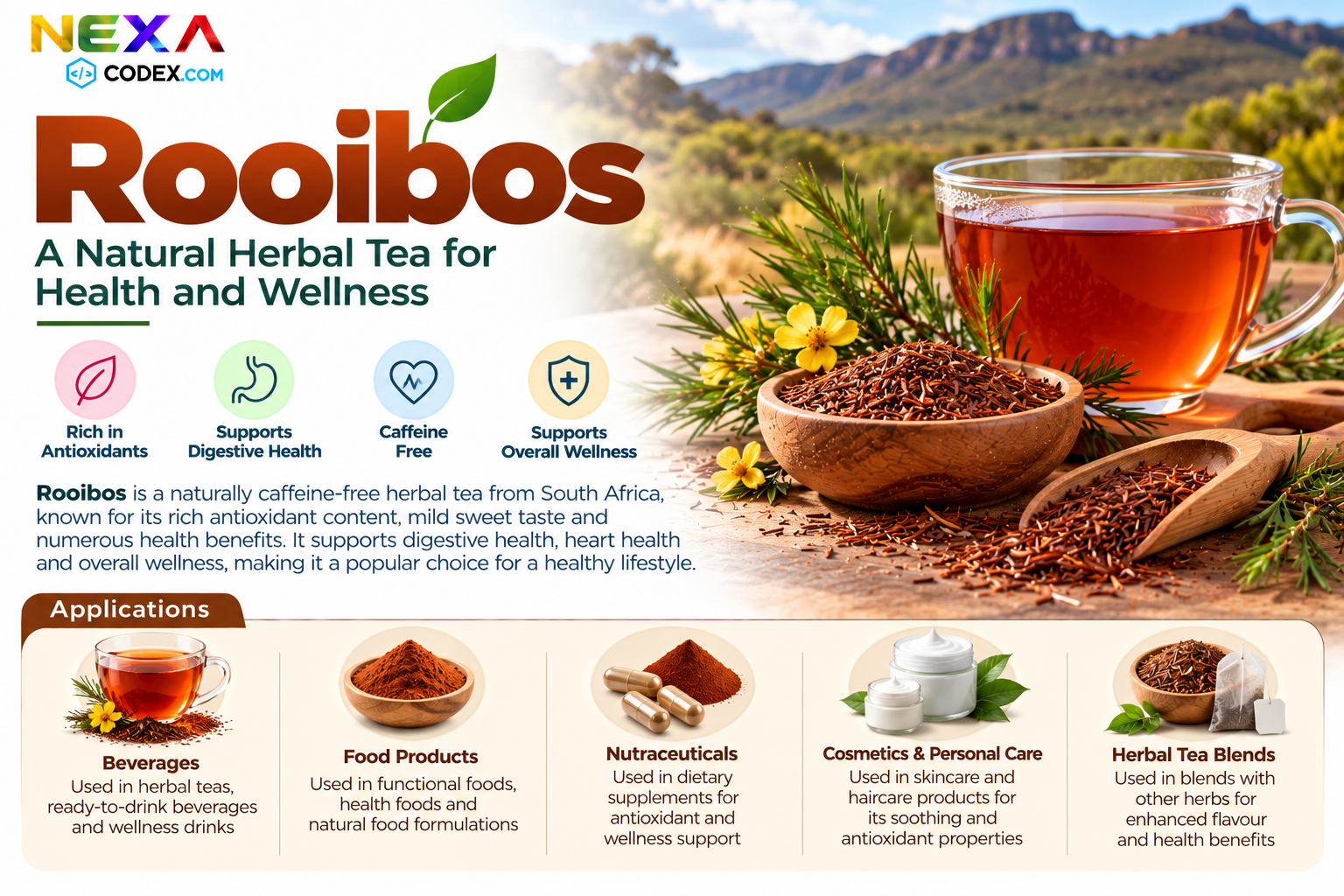
Rooibos, scientifically known as Aspalathus linearis, is a distinctive South African botanical widely recognised for its use in naturally caffeine-free herbal tea and specialty beverage products. Also known as red bush, rooibos is valued for its characteristic aroma, earthy flavour, reddish-brown colour in its traditional processed form, and naturally occurring plant polyphenols. It is used in herbal infusions and may also be considered for selected food, beverage, cosmetic, and botanical extract applications, depending on the grade and applicable regulations.
Mediocon Inc. presents Rooibos as a botanical ingredient for businesses exploring herbal tea, beverage, and plant-based product development. The material may be supplied in different forms depending on the available product range, including dried leaves and stems, cut botanical material, powder, or extract. Buyers should confirm the exact product form, botanical identity, country of origin, grade, and technical specifications before procurement.
Rooibos belongs to the Fabaceae family and originates from the fynbos regions of South Africa, particularly areas of the Western Cape. The plant has fine, needle-like leaves and is cultivated or harvested for the production of traditional herbal infusions. Its botanical identity distinguishes it from conventional black and green tea, which are produced from Camellia sinensis.
The characteristics of rooibos depend on its botanical source, harvesting practices, processing method, drying conditions, and storage. For commercial applications, buyers should verify the botanical name, source, processing type, and traceability information against the supplier's documentation.
Rooibos is commonly available in two principal forms. Red rooibos undergoes oxidation during processing, resulting in its familiar reddish-brown colour and smooth, earthy flavour. Green rooibos is processed to limit oxidation, retaining a greener appearance and a different profile of naturally occurring plant compounds.
Both forms can be used in appropriate herbal tea and botanical applications. Selection depends on the intended flavour, colour, processing requirements, and any target constituents specified for the finished product.
Rooibos contains various naturally occurring polyphenols, including aspalathin and nothofagin. Their concentrations can vary according to the botanical material, processing method, and whether the product is red rooibos, green rooibos, or a concentrated extract.
For standardised botanical applications, the concentration of a marker compound should be verified using the relevant analytical method and a current certificate of analysis. No specific concentration should be assumed without supporting product documentation.
Rooibos is commonly used to prepare herbal infusions and caffeine-free tea products. It can be presented as loose-leaf material, tea-bag cuts, or suitable blends with other botanicals and flavour ingredients. Product development should consider flavour consistency, botanical authenticity, moisture control, and microbiological quality.
Rooibos may be evaluated for suitable beverage concepts, including brewed drinks and selected botanical beverage formulations. The ingredient form, extraction characteristics, flavour, colour, and stability should be assessed during formulation development.
Depending on the grade and applicable regulations, rooibos may be considered for selected food products where its botanical flavour and colour are appropriate. Suitability should be confirmed for each intended application.
Rooibos extracts may be used in certain botanical formulations. Extracts differ from ordinary dried leaves and stems in concentration, composition, and processing characteristics. Buyers should confirm the extract specifications, solvent information where applicable, standardisation requirements, and regulatory suitability.
Selected rooibos-derived ingredients may be considered for cosmetic and personal-care formulations. Their use requires appropriate ingredient documentation, formulation compatibility assessment, and safety review for the intended application.
Quality assurance is essential for consistent botanical ingredients. Depending on the grade and intended use, relevant checks may include botanical identity, appearance, odour, moisture content, foreign matter, microbiological quality, contaminants, pesticide residues, and marker-compound analysis where applicable.
Buyers should request the current technical data sheet and batch-specific certificate of analysis. Numerical limits and test methods should follow the approved specification for the exact product rather than generic values.
Rooibos should be stored in suitable, sealed packaging that protects it from excessive moisture, contamination, strong odours, and unsuitable environmental conditions. Storage temperature, shelf life, packaging format, and transport requirements must follow the product-specific documentation.
Finished tea, beverage, or extract formulations should undergo appropriate stability testing to confirm quality throughout the intended shelf life.
Rooibos is associated with South African botanical origin. Businesses should confirm the actual country of origin, processing location, grade, and supporting documentation before purchase. The term “Rooibos” should accurately describe the botanical material and should not be used to imply an origin or certification that has not been verified.
For food, nutraceutical, and cosmetic applications, compliance requirements depend on the finished product and destination market. Buyers should confirm applicable ingredient permissions, import requirements, labelling obligations, and quality standards.
Mediocon Inc. provides a point of contact for businesses seeking information about rooibos and related botanical ingredients. Commercial enquiries can cover product form, grade, technical specifications, packaging, availability, and sourcing requirements. Actual stock, pricing, lead times, and manufacturing or processing capabilities should be confirmed before an order is placed.
Rooibos (Aspalathus linearis) is a distinctive botanical used primarily in herbal tea and also considered for selected beverage, food, nutraceutical, and cosmetic applications. Its characteristic flavour, naturally caffeine-free nature, and plant polyphenols make it an established ingredient in botanical product development.
Choosing the appropriate material requires confirmation of botanical identity, red or green processing type, grade, quality specifications, and intended application. Contact Mediocon Inc. for product information and technical documentation relevant to the specific rooibos material required.
| Parameter | Specification |
|---|---|
| Appearance | Dried needle-like leaves and fine stems |
Mediocon Inc is a GMP-certified API manufacturer and bulk pharmaceutical ingredient supplier based in Aurangabad, Maharashtra, India. We specialise in supplying Rooibos Manufacturer in India | Mediocon Inc. and over 1,000 other Active Pharmaceutical Ingredients, excipients, herbal extracts, and nutraceutical ingredients to pharmaceutical manufacturers worldwide.
Our Rooibos Manufacturer in India | Mediocon Inc. is manufactured under strict quality management protocols compliant with WHO-GMP, ISO 9001:2015, and major pharmacopoeial standards (IP, BP, USP, EP). Every batch undergoes full analytical testing before release with a Certificate of Analysis.
Export Markets
Quality & Compliance