
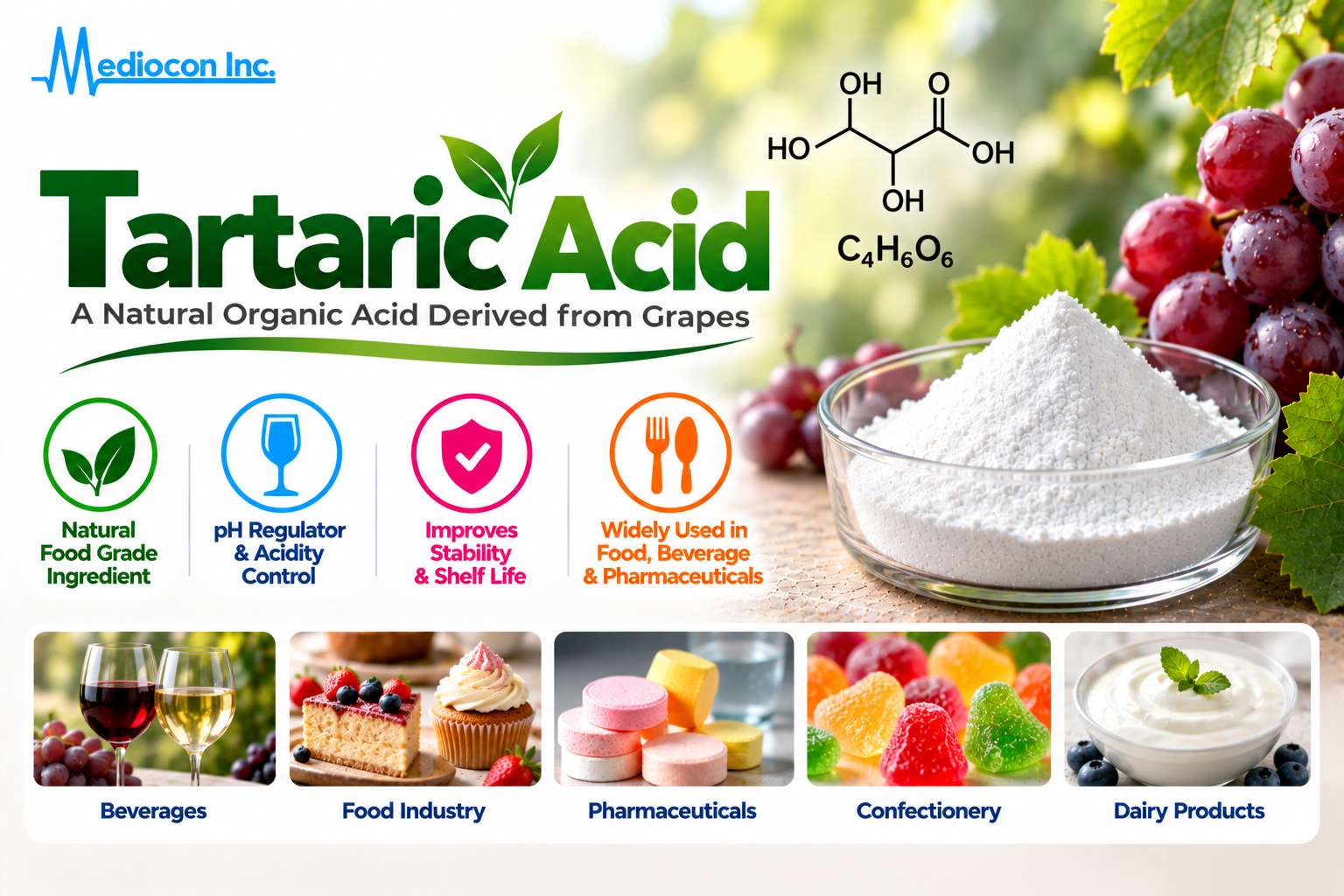
Tartaric Acid is a naturally occurring organic acid found in various plants, particularly grapes and tamarinds. It is widely used in food processing, beverages, confectionery, baking, wine production, and selected pharmaceutical and industrial applications. In food applications, it is identified by the additive number E334 and is used for its acidic taste and its ability to help regulate acidity in suitable formulations.
Tartaric acid has the molecular formula C4H6O6 and a molecular weight of approximately 150.09 g/mol. Commercial material is available in different stereochemical forms and grades. The exact CAS number, optical rotation, assay, and applicable specification depend on the form being supplied. Buyers should therefore confirm whether they require L-(+)-tartaric acid, DL-tartaric acid, or another specified form.
Tartaric acid is a dicarboxylic acid containing two hydroxyl groups. Its chemical structure contributes to its acidic character and its ability to interact with other formulation ingredients. Depending on the grade and stereochemical form, the material is commonly supplied as a white crystalline powder or crystals.
The chemical identity should be verified using the product's name, CAS number, molecular formula, molecular weight, and relevant identification tests. For L-(+)-tartaric acid, the commonly listed CAS number is 87-69-4. DL-tartaric acid has a different CAS number, so these forms should not be treated as interchangeable in product documentation.
Tartaric acid is used as an acidulant and acidity regulator in suitable food and beverage formulations. It can contribute a sharp acidic taste and help formulators adjust the pH of a product. Depending on the recipe and applicable regulations, it may be used in confectionery, beverages, fruit preparations, baking products, and other processed foods.
In baking, tartaric acid may be used in selected leavening systems and formulations involving alkaline ingredients. In confectionery, it can help create a characteristic sour flavour. In beverage applications, it can support acidity adjustment and the desired flavour balance. The appropriate amount depends on the recipe, ingredient compatibility, required sensory profile, and applicable food standards.
Tartaric acid is an important acid in winemaking and is naturally associated with grapes. It may be used in specific wine-processing applications to adjust acidity, subject to local wine regulations and approved production practices. Its role in wine is distinct from its use as a general-purpose acidulant in other foods.
Tartaric acid may also be relevant to fruit-based products and processing systems where acidity management is required. The suitability of the ingredient depends on the formulation, processing conditions, and intended finished product.
Depending on the grade and relevant specifications, tartaric acid may be used in certain pharmaceutical formulations, laboratory applications, chemical preparations, and other industrial processes. The specific requirements differ by application. Food-grade material should not automatically be assumed suitable for pharmaceutical manufacturing, and technical or industrial grade material should not be used in food applications without the required qualification and compliance.
For pharmaceutical or other regulated applications, buyers should confirm the applicable pharmacopoeial or customer specification, impurity limits, testing methods, and documentation requirements.
The quality of commercial tartaric acid is determined by its chemical identity, stereochemical form, assay, optical rotation where applicable, moisture content, residue on ignition, impurity profile, and other parameters defined by the selected grade. Food and pharmaceutical grades may have different acceptance criteria.
A reliable product specification should identify the exact form of tartaric acid and include relevant analytical methods and acceptance limits. The Certificate of Analysis should correspond to the supplied batch and report actual test results. Numerical specifications should not be copied from a different grade or supplier without confirmation.
Tartaric acid should be stored in suitable, tightly closed packaging under the conditions specified by the supplier. Protect the material from contamination and moisture, and follow the approved label and Safety Data Sheet for handling precautions. Packaging options and shelf life depend on the product, supplier, and commercial grade.
Before use, review the relevant safety documentation and ensure that handling, storage, and transport comply with the requirements applicable to the intended application.
Businesses sourcing tartaric acid should confirm the required stereochemical form, grade, assay, packaging, quantity, destination market, and documentation requirements before requesting a quotation. Food manufacturers may require food-grade documentation, while pharmaceutical customers may need compliance with a specified pharmacopoeia or internal quality standard.
Mediocon Inc. can publish product information and respond to commercial enquiries according to its verified supply arrangements. Manufacturer identity, current availability, certifications, and regulatory claims should be confirmed before publication or sale.
Tartaric acid is a versatile organic acid used in food, beverage, confectionery, baking, winemaking, and selected pharmaceutical and industrial applications. Accurate product selection requires attention to stereochemical form, grade, chemical identity, assay, and application-specific specifications. Current supplier documentation should be used to establish the exact values and quality requirements for the material being offered.
Mediocon Inc is a GMP-certified API manufacturer and bulk pharmaceutical ingredient supplier based in Aurangabad, Maharashtra, India. We specialise in supplying Tartaric Acid Manufacturer in India | Mediocon Inc. and over 1,000 other Active Pharmaceutical Ingredients, excipients, herbal extracts, and nutraceutical ingredients to pharmaceutical manufacturers worldwide.
Our Tartaric Acid Manufacturer in India | Mediocon Inc. is manufactured under strict quality management protocols compliant with WHO-GMP, ISO 9001:2015, and major pharmacopoeial standards (IP, BP, USP, EP). Every batch undergoes full analytical testing before release with a Certificate of Analysis.
Export Markets
Quality & Compliance