
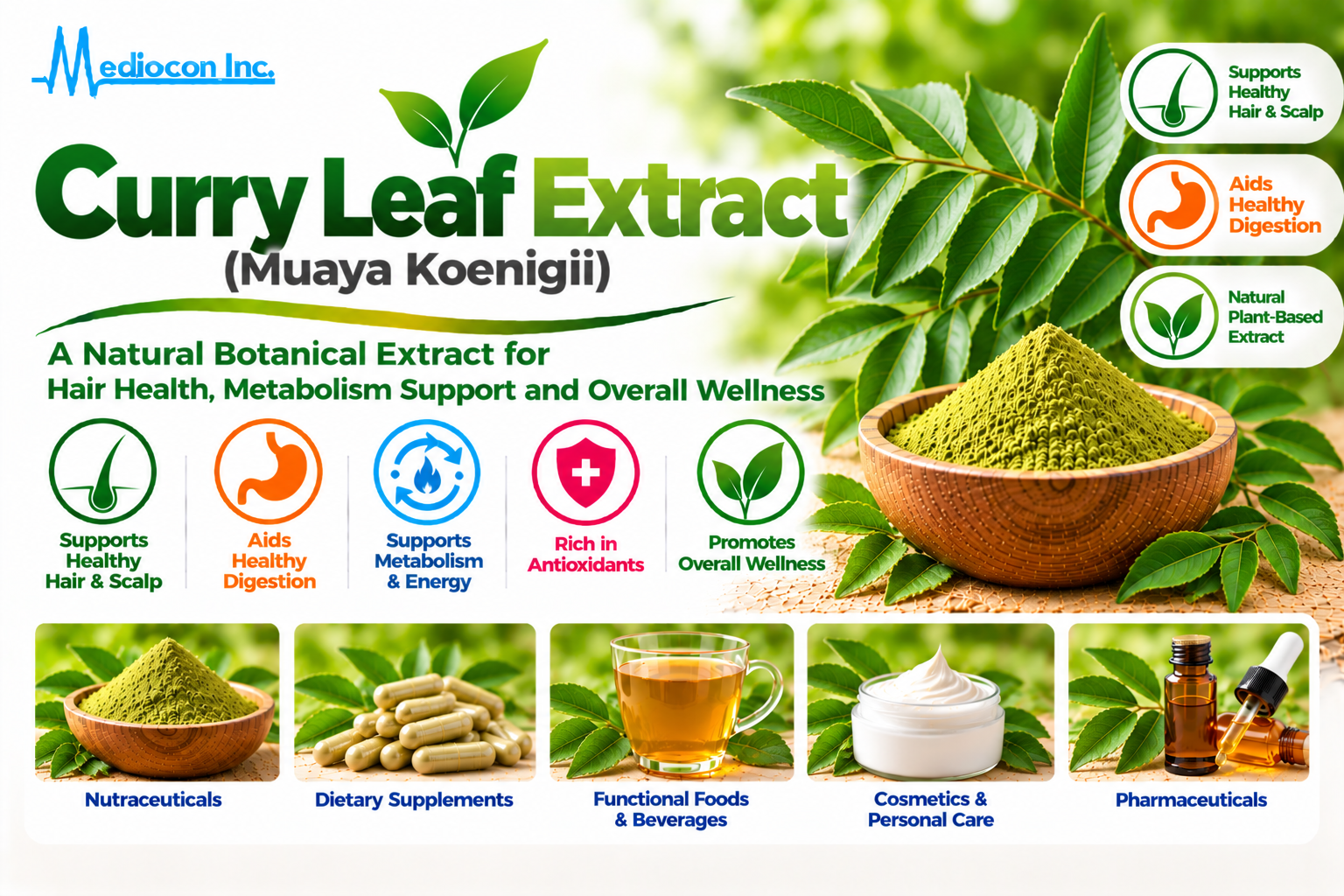
Curry Leaf Extract is obtained from the curry leaf plant, Murraya koenigii, a small tree native to the Indian subcontinent and widely cultivated in tropical and subtropical regions. Its aromatic leaves are valued in culinary traditions and have also been investigated for their phytochemical composition.
The plant contains various naturally occurring compounds, including carbazole alkaloids, flavonoids, and volatile constituents. Their presence and concentration vary depending on the plant part, geographical origin, growing conditions, harvesting practices, and extraction process.
Commercial Curry Leaf Extract may be available in different forms and grades. Before selecting a product, buyers should confirm whether it is derived from leaves or another plant part and review the relevant analytical specifications.
Curry leaves are processed using suitable extraction techniques to obtain botanical ingredients with different chemical profiles. The final composition depends on the extraction solvent, processing conditions, and concentration method.
Botanical clarification: Curry leaf (Murraya koenigii) is different from neem (Azadirachta indica). The common name “sweet neem” should not be used to imply that the two plants are botanically identical.
Carbazole alkaloids are an important group of compounds investigated in Murraya koenigii. Compounds reported in curry leaf research include mahanine, girinimbine, and mahanimbine. Their presence and concentration depend on the plant material and extraction method.
Flavonoids are naturally occurring plant compounds that may be present in curry leaf materials. Their levels vary with the plant source, processing conditions, and analytical method.
Curry leaves contain phenolic constituents that have been investigated in phytochemical studies. The precise composition of an extract should be established through suitable analytical testing.
Curry leaves have a characteristic aroma associated with volatile compounds. Their concentration in an extract depends on the extraction process, and some volatile constituents may be reduced or absent in certain concentrated extracts.
Not every Curry Leaf Extract contains the same compounds or concentrations. Any claim about a specific marker or standardized composition should be supported by the actual product specification and Certificate of Analysis (CoA).
Curry Leaf Extract is relevant to research involving carbazole alkaloids, plant chemistry, extraction techniques, and analytical characterization. Researchers may evaluate its chemical profile and compare extracts prepared using different methods.
Curry leaves are widely used as a culinary ingredient. Certain curry leaf-derived ingredients may be evaluated for food-related applications where the ingredient grade, intended use, and applicable food regulations permit.
An extract should not automatically be treated as a food flavouring or food additive without confirming its regulatory status and suitability.
Ingredient developers may evaluate Curry Leaf Extract for selected formulation projects. Suitability depends on the extract's composition, physical properties, stability, safety documentation, and intended product category.
Curry leaf materials may be assessed for botanical identity, marker compounds, extract consistency, and relevant quality parameters. HPLC or other appropriate analytical methods may be used where suitable for the compounds being measured.
These potential applications do not establish clinical effectiveness or guarantee suitability for every product. Any health-related or functional claim should be supported by appropriate evidence and regulatory review.
Quality control is important when sourcing Curry Leaf Extract for research or commercial use. Depending on the grade, specifications may include:
A validated analytical method should be used for any stated marker-compound assay. The method, reference standard, and reporting basis should be documented.
A current batch-specific CoA should be reviewed before publishing numerical assay values or claims about standardization.
Store Curry Leaf Extract according to the product-specific technical documentation. Use suitable packaging and protect the material from excessive heat, moisture, and unsuitable environmental conditions.
Follow the applicable safety data sheet and handling instructions for the exact product.
When selecting Curry Leaf Extract, buyers should verify the botanical identity, plant part, extraction method, extract form, and any specified marker compounds. Product documentation should clearly state the analytical methods and quality acceptance criteria.
Different extracts can vary substantially in chemical composition. Reviewing the technical data sheet and CoA helps determine whether the product meets the intended requirements.
Curry Leaf Extract (Murraya koenigii) is a botanical ingredient with a distinctive phytochemical profile, including carbazole alkaloids and other plant-derived constituents. Its composition and suitability depend on the source material, extraction process, quality testing, and intended application.
For informed ingredient selection, review the product specifications and batch-specific CoA before making purchasing or formulation decisions.
| Parameter | Specification |
|---|---|
| Identification | Murraya koenigii (L.) Spreng |
Mediocon Inc is a GMP-certified API manufacturer and bulk pharmaceutical ingredient supplier based in Aurangabad, Maharashtra, India. We specialise in supplying Curry Leaf Extract (Murraya koenigii) Manufacturer in India | Mediocon Inc. and over 1,000 other Active Pharmaceutical Ingredients, excipients, herbal extracts, and nutraceutical ingredients to pharmaceutical manufacturers worldwide.
Our Curry Leaf Extract (Murraya koenigii) Manufacturer in India | Mediocon Inc. is manufactured under strict quality management protocols compliant with WHO-GMP, ISO 9001:2015, and major pharmacopoeial standards (IP, BP, USP, EP). Every batch undergoes full analytical testing before release with a Certificate of Analysis.
Export Markets
Quality & Compliance