
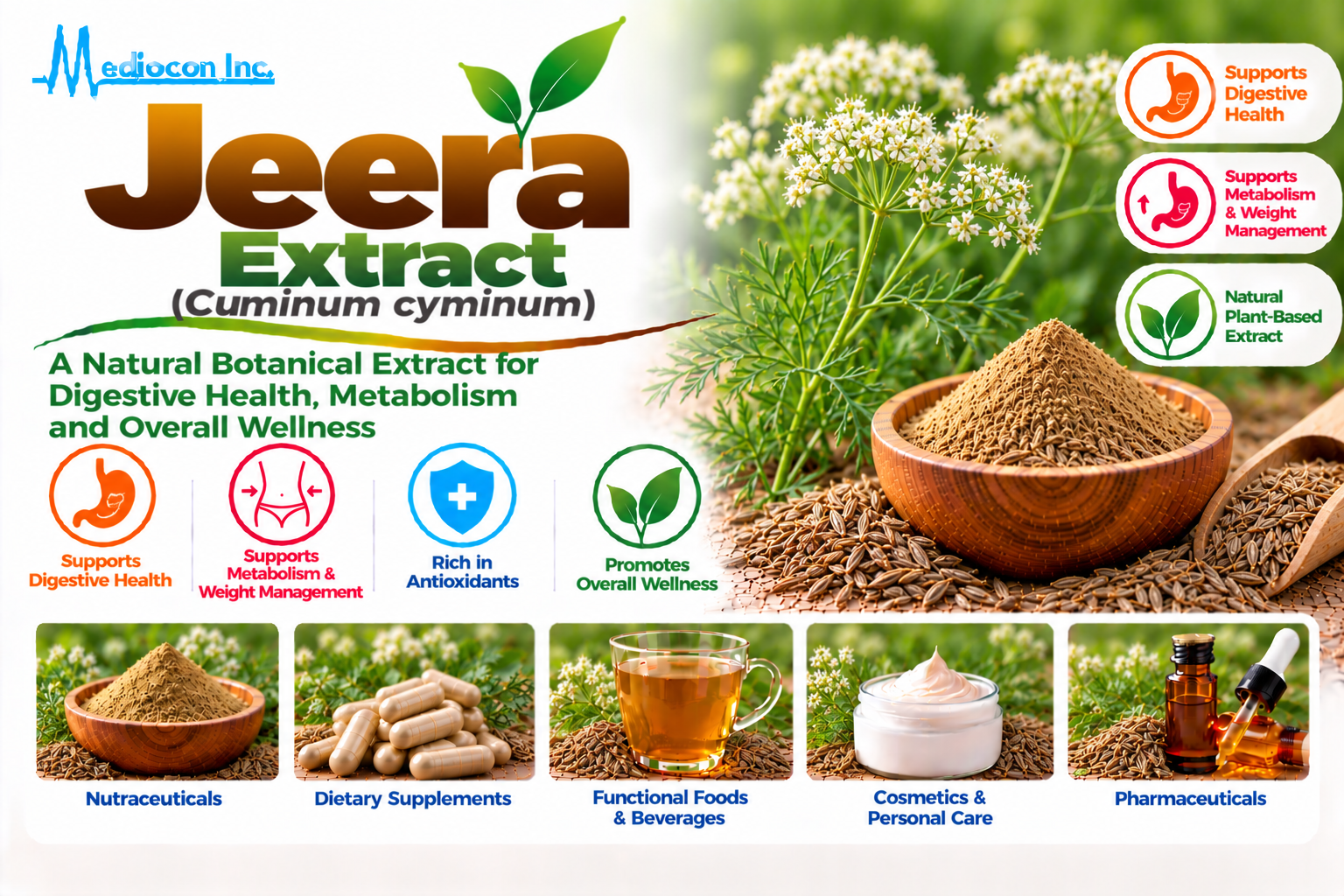
Jeera, commonly known as cumin, is one of the most widely used aromatic spices in Indian and international cuisine. Botanically identified as Cuminum cyminum L., cumin belongs to the Apiaceae family and is valued for its characteristic aroma, warm flavor, and naturally occurring plant compounds. Beyond its culinary importance, cumin has attracted scientific interest for its chemical composition, extraction methods, and potential applications in food technology, botanical research, and ingredient development.
Jeera Extract is a concentrated botanical preparation obtained from cumin seeds, botanically classified as the dried fruits of the plant. Depending on the extraction method, the resulting ingredient may contain different proportions of volatile compounds, non-volatile constituents, and other naturally occurring phytochemicals.
The properties of Jeera Extract depend on the raw material, solvent system, extraction conditions, and processing method. Products may be supplied as powdered extracts, liquid extracts, oleoresins, or essential oils. These forms are not interchangeable because each has a different composition and set of technical characteristics.
For food manufacturers, ingredient buyers, researchers, and product developers, understanding the botanical identity, composition, processing methods, and quality requirements of Jeera Extract is essential when selecting a suitable ingredient.
Jeera Extract is a plant-derived ingredient produced by extracting selected constituents from cumin seeds. The extraction process separates certain compounds from the original plant material and concentrates them into a form suitable for a defined application.
Depending on the manufacturing process, an extract may retain aromatic compounds responsible for cumin's characteristic smell and flavor, or it may contain a broader range of non-volatile plant constituents.
Common commercial forms related to cumin include:
These products have different specifications. A cumin essential oil, for example, should not be described as equivalent to a powdered Jeera Extract without supporting technical evidence.
Before purchasing or using Jeera Extract, buyers should confirm the product form, extraction solvent, plant material, extraction ratio, standardization, and intended application.
Correct botanical identification is important for maintaining consistency in the botanical ingredient supply chain.
Botanical classification
Cumin is cultivated in India and other regions with suitable growing conditions. The aroma and chemical profile of the harvested material can vary according to cultivar, climate, soil conditions, maturity, post-harvest handling, and storage.
The term “Jeera Extract” may refer to different commercial preparations. Therefore, a detailed product specification should identify the botanical source and clearly describe the form of extract being supplied.
Cumin contains a complex mixture of naturally occurring chemical constituents. The composition of a commercial extract is influenced by the plant material, extraction solvent, processing temperature, and concentration method.
Cuminaldehyde is an important aromatic compound associated with cumin's characteristic smell and flavor. It has received attention in chemical and biological research involving cumin-derived ingredients.
Its concentration can vary between raw materials and extraction methods. A product should not be marketed as standardized to cuminaldehyde unless the relevant analytical test and specification support that claim.
Cumin contains volatile compounds belonging to the broader terpene and terpenoid groups. These compounds contribute to its aromatic profile and may vary in relative abundance depending on the source material and processing conditions.
Because volatile compounds can be sensitive to heat, oxygen, and storage conditions, the manufacturing process and packaging can influence the final aroma profile.
The volatile fraction of cumin may contain a mixture of aromatic constituents in addition to cuminaldehyde. The exact profile depends on the product form and analytical method.
This is particularly relevant when cumin is used as a flavoring ingredient. Manufacturers may require a specific aroma profile or chemical composition to achieve consistent results across batches.
Phenolic compounds are a broad group of plant-derived substances that have been investigated in cumin and other botanical materials. Some have shown antioxidant activity in laboratory testing.
However, the amount recovered in a particular extract depends on the extraction conditions. Results from one laboratory extract cannot automatically be applied to every commercial Jeera Extract.
Scientific reviews have described flavonoids and other phytochemicals in cumin. Their presence and concentration can differ according to the plant material and extraction procedure.
Where a particular phytochemical is important to a product's performance or specification, its identity and concentration should be established using a suitable analytical method.
The manufacturing process depends on the desired product form and the compounds that need to be recovered. A typical botanical extraction process may include the following stages.
Cumin seeds are selected according to botanical identity, quality, condition, and intended application. Raw materials should be assessed for visible contamination, foreign matter, moisture, and other relevant quality parameters.
Traceability records can help identify the origin and batch of the raw material.
The seeds may be cleaned to remove dust and foreign material. Depending on the extraction process, the material may then be crushed or ground to improve contact between the plant material and the extraction medium.
Grinding conditions should be controlled because excessive heat may affect volatile aromatic constituents.
The prepared material is processed using a suitable extraction method. Water, food-compatible solvents, or other appropriate extraction media may be used depending on the desired product and applicable regulations.
Different solvents recover different groups of compounds. Therefore, water extracts, solvent extracts, oleoresins, and essential oils may have substantially different compositions.
The extracted liquid is separated from the spent plant material. It may then be filtered and concentrated according to the intended product specifications.
Process controls are important to maintain a consistent composition and to manage residual solvent levels where applicable.
If a powder is required, the concentrated extract may be dried using a suitable method. A liquid extract or oleoresin may instead undergo further concentration, clarification, or other finishing operations.
The finished product should be assessed for its physical characteristics and compliance with the approved specification.
The final batch may be tested for identity, assay, moisture, contaminants, microbiological quality, and other relevant parameters. The required tests depend on the product form and intended use.
Packaging should protect the ingredient from conditions that may compromise its stability, particularly where volatile aromatic constituents are important.
Jeera Extract may be evaluated for several industrial and research applications, depending on its composition, grade, and regulatory suitability.
Cumin is widely used as a culinary spice and flavoring ingredient. Selected cumin-derived preparations may be considered for sauces, seasoning blends, soups, snack foods, marinades, and other suitable food products.
The specific extract should be selected according to the desired flavor intensity, aroma, color, solubility, and compatibility with the formulation.
A food application requires confirmation that the ingredient is suitable for that use and complies with the applicable food regulations. A general-purpose botanical extract should not automatically be considered food grade.
Cumin is an important ingredient in many spice blends. Cumin-derived extracts may be evaluated when manufacturers want to control flavor delivery or achieve consistency in a processed food formulation.
The suitability of an extract depends on its aromatic profile, concentration, physical form, and interactions with other ingredients.
For commercial seasoning development, the technical specification should describe the product's identity and relevant flavor or analytical characteristics.
Cumin oleoresin and other concentrated preparations may be considered in flavor-development applications where permitted. Concentrated ingredients can differ from ground cumin in their handling properties and flavor intensity.
Manufacturers should conduct formulation trials to establish the appropriate incorporation level and assess flavor stability throughout processing and storage.
The product form should be clearly identified because an essential oil, oleoresin, and dried extract can behave differently in the same formulation.
Cumin and its constituents have been investigated in nutritional and botanical research. Certain cumin-derived preparations may be studied for their phytochemical profile and laboratory-measured biological activities.
However, suitability for a nutraceutical product depends on the precise ingredient, its safety profile, permitted use, and regulatory requirements in the target market. Research on cumin as a spice does not establish the efficacy of every concentrated extract.
Selected cumin-derived ingredients may be evaluated during cosmetic formulation research, depending on their composition and suitability for topical use.
Developers should assess odor, color, formulation compatibility, stability, irritation potential, and other relevant safety factors. Essential oils and concentrated aromatic ingredients require particular care because their properties differ from those of ordinary culinary cumin.
Cosmetic ingredients should be used only in accordance with applicable safety and regulatory requirements.
Jeera Extract may be used in research involving botanical chemistry, extraction efficiency, aromatic compound analysis, and ingredient characterization.
Researchers can compare extraction conditions to determine how they influence the recovered chemical profile. Such studies can help establish reproducible manufacturing processes and appropriate quality specifications.
For industrial buyers, Jeera Extract may be considered as a specialized botanical ingredient when its properties meet a defined application requirement.
Selection should be based on documented technical characteristics rather than the general name of the plant alone. Product form, solvent history, standardization, and quality requirements are important considerations.
Scientific literature has investigated cumin's chemical composition and several biological activities under laboratory and other experimental conditions.
Some cumin-derived extracts and isolated compounds have demonstrated antioxidant activity in laboratory studies. The results depend on the composition of the tested material and the experimental method.
An antioxidant result obtained in a laboratory assay does not, by itself, prove a health benefit in humans or establish the effectiveness of a particular commercial ingredient.
Cumin essential oils and certain extracts have been studied for activity against selected microorganisms under experimental conditions.
Such findings do not automatically establish that Jeera Extract can preserve food, prevent infections, or replace approved antimicrobial treatments. Any practical application requires appropriate validation and regulatory review.
Researchers have investigated cumin in relation to several metabolic and physiological outcomes. The strength of the evidence varies according to the preparation, experimental model, study design, and population.
It is important to distinguish preliminary laboratory findings from reliable clinical evidence. Concentrated extracts should not be presented as treatments for diabetes, obesity, or other medical conditions without appropriate evidence and authorization.
Some experimental studies have examined cumin-derived materials in inflammation-related models. These findings may support further scientific investigation but do not establish that every cumin extract has a clinically meaningful anti-inflammatory effect.
The composition and concentration of the material used in research must be considered before interpreting the results.
Overall, scientific reviews identify cumin as a chemically diverse spice with several areas of research interest. More appropriately designed studies are needed to clarify the clinical relevance of many proposed health effects.
The quality of a botanical extract depends on the complete production chain, from raw material sourcing to finished-product storage.
The starting material should be correctly identified as Cuminum cyminum L. Authenticity checks help reduce the risk of substitution, adulteration, or the use of unsuitable raw material.
Moisture can influence the stability of powdered extracts and may affect microbial quality. Storage conditions should be established according to the product's characteristics and supporting stability data.
The extraction solvent affects the compounds recovered from cumin. The solvent system should be suitable for the intended application, and residual-solvent testing should be performed when relevant.
Some extracts are standardized to a selected compound or analytical characteristic. The marker, test method, and acceptable range should be specified clearly.
Standardization should never be inferred merely from the phrase “concentrated extract.”
Where aromatic constituents are important, processing, packaging, and storage can affect the volatile profile. A suitable analytical method may be needed to confirm the required composition.
Depending on the grade and intended application, quality testing may cover heavy metals, pesticide residues, microbiological contamination, foreign matter, and other relevant contaminants.
Testing requirements and acceptance limits should follow the applicable specification and regulations.
A technical data sheet and batch-specific Certificate of Analysis are useful documents when evaluating Jeera Extract.
The documentation may cover the following parameters, as appropriate:
Not every parameter applies to every product. For example, an essential oil may require a different analytical profile from a dried water extract.
Exact assay percentages, extraction ratios, and acceptance limits should be entered only after verification against the relevant product documentation.
Selecting a suitable grade requires a clear understanding of the intended application.
Determine whether the ingredient is intended for food flavoring, botanical research, cosmetic formulation, or another permitted use. The application will influence the required grade and testing.
Establish whether the required ingredient is a powdered extract, liquid extract, oleoresin, or essential oil. These forms should not be treated as equivalent.
Check the botanical identity, extraction solvent, standardization, assay, physical characteristics, and applicable contaminant limits.
The CoA should correspond to the batch being evaluated. Compare the reported results with the approved purchasing specification.
Verify that the ingredient and its intended use comply with the requirements of the target market. Food, nutraceutical, cosmetic, and research applications may have different requirements.
Confirm that the packaging protects the ingredient's relevant characteristics and that the storage instructions are appropriate for the product.
Before ordering, verify availability, quantity, packaging, lead time, pricing, and the documentation provided by the vendor.
Standardization can help manufacturers manage variation between batches when a specified marker compound or analytical characteristic is important to product performance.
Cumin is a natural botanical material, and its composition may vary according to growing conditions, raw material handling, and processing. An extract produced under one set of conditions may not have the same profile as an extract made using a different method.
A useful specification should identify the relevant marker, describe the test method, and define an acceptable range based on actual product data. It should also distinguish between a marker compound, a total-compound measurement, and an extraction ratio.
These distinctions support clearer purchasing requirements, more reproducible formulation work, and more accurate product descriptions.
Cumin is widely used as a culinary spice, but concentrated extracts and essential oils can differ substantially from ordinary food quantities in composition and exposure.
Safety should be evaluated according to the product form, concentration, intended use, impurities, and route of exposure. Ingredients intended for topical use, food use, or other applications require appropriate assessment for that purpose.
Traditional use and preliminary laboratory research should not be treated as proof that a concentrated extract prevents or treats a disease. Manufacturers should avoid unsupported medical claims and confirm the relevant regulatory requirements before marketing a finished product.
Where a product is intended for human consumption, the ingredient's permitted use, quality, and appropriate conditions of use should be established from reliable documentation.
Jeera Extract is a botanical preparation derived from cumin, Cuminum cyminum L. Its composition depends on the extraction process and the product form.
The botanical name is Cuminum cyminum L. The plant belongs to the Apiaceae family.
The dried fruits, commonly called cumin seeds, are the main raw material used for commercial cumin products. The exact plant material should be confirmed in the product specification.
Cumin contains aromatic compounds such as cuminaldehyde, as well as other volatile and non-volatile constituents. The composition of a particular extract depends on its processing method.
No. Essential oil is a volatile aromatic preparation, while other extracts may contain a different mixture of volatile and non-volatile constituents. Their specifications and uses can differ.
Depending on the grade and regulatory suitability, cumin-derived ingredients may be considered for food flavoring, seasoning development, botanical research, and selected formulation applications.
Testing may include botanical identification, physical characteristics, marker-compound analysis, moisture, contaminants, microbiological quality, and residual solvents where relevant.
Cuminaldehyde is an aromatic compound associated with cumin's characteristic smell and flavor. Its concentration varies by material and processing method.
Storage conditions should follow the product-specific technical specification. Packaging should protect the ingredient from conditions that could affect its stability and, where relevant, aromatic constituents.
Buyers should verify the product form, botanical identity, extraction method, standardization, technical specification, batch-specific CoA, intended-use suitability, and commercial terms.
No. Suitability depends on the ingredient's grade, composition, safety assessment, formulation, and applicable regulations. Approval for one application does not automatically establish suitability for another.
No. Research findings depend on the specific material and study design. Laboratory observations do not establish clinical benefits for every commercial extract.
Jeera Extract, derived from Cuminum cyminum L., is a botanical ingredient associated with cumin's characteristic aromatic compounds and diverse phytochemical profile. Its applications may include food flavoring, seasoning development, botanical research, and selected ingredient-development activities, depending on the product form and applicable regulations.
The characteristics of Jeera Extract are determined by the raw material, extraction solvent, processing conditions, concentration method, and standardization requirements. Cumin powder, oleoresin, essential oil, and powdered extract should therefore be evaluated as distinct products.
For manufacturers, researchers, and ingredient buyers, the most important considerations include botanical identity, product form, chemical profile, batch consistency, contaminant testing, traceability, and regulatory suitability. Reviewing the technical data sheet and Certificate of Analysis can help determine whether a particular grade meets the requirements of its intended application.
Mediocon Inc. product information should reflect verified specifications and actual product availability. Accurate documentation and clear descriptions help customers evaluate Jeera Extract responsibly and make informed ingredient-selection decisions.
Mediocon Inc is a GMP-certified API manufacturer and bulk pharmaceutical ingredient supplier based in Aurangabad, Maharashtra, India. We specialise in supplying Jeera Extract (Cuminum cyminum) Manufacturer in India | Mediocon Inc. and over 1,000 other Active Pharmaceutical Ingredients, excipients, herbal extracts, and nutraceutical ingredients to pharmaceutical manufacturers worldwide.
Our Jeera Extract (Cuminum cyminum) Manufacturer in India | Mediocon Inc. is manufactured under strict quality management protocols compliant with WHO-GMP, ISO 9001:2015, and major pharmacopoeial standards (IP, BP, USP, EP). Every batch undergoes full analytical testing before release with a Certificate of Analysis.
Export Markets
Quality & Compliance