
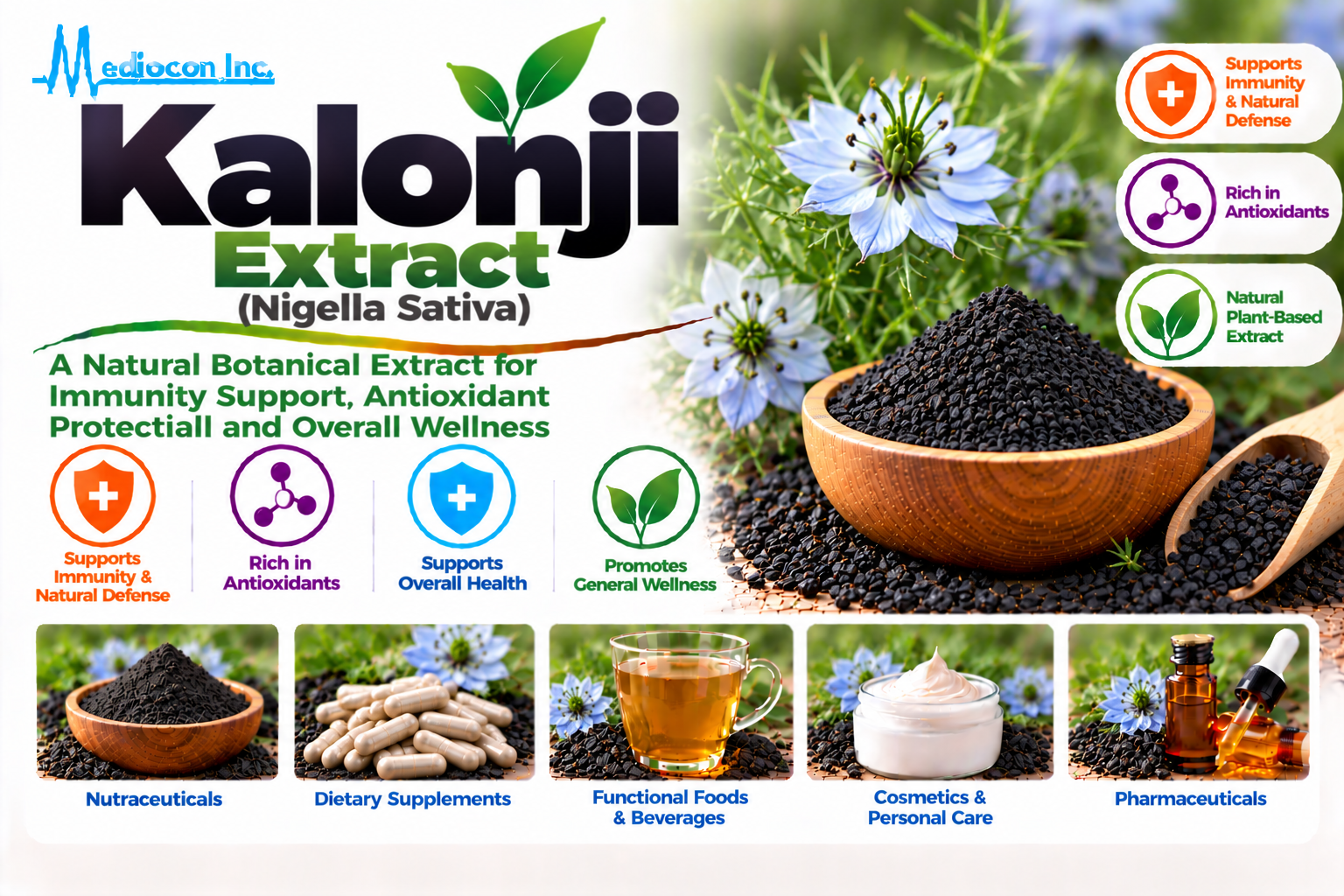
Kalonji Extract is a botanical ingredient derived from the seeds of Nigella sativa, a flowering plant belonging to the Ranunculaceae family. Commonly known as black seed, black cumin, or black caraway in different contexts, Kalonji has a long history of culinary and traditional use in various regions. Its seeds are valued for their distinctive aroma, characteristic taste, and naturally occurring plant compounds.
In addition to its traditional culinary applications, Kalonji is of interest to the botanical ingredient, nutraceutical, food, and research industries. The seeds contain several constituents, including thymoquinone, fixed oils, fatty acids, and other phytochemicals. The composition of a commercial extract depends on the seed quality, extraction method, processing conditions, and standardization requirements.
Kalonji Extract is available in different forms, including seed extracts and oil-based preparations. These products should not be treated as interchangeable because their physical properties and chemical compositions can differ considerably. Understanding the botanical source, extraction process, and analytical specifications is essential when selecting an ingredient for a particular application.
Nigella sativa is an annual flowering plant native to parts of Southwest Asia and cultivated in several regions. It belongs to the Ranunculaceae family and produces small seeds that are widely known as Kalonji or black seed.
The seeds are commonly used as a spice in culinary preparations. They have a distinctive flavour and aroma and are incorporated into various traditional foods. Beyond their culinary use, black seeds have been investigated for their chemical composition and potential applications in botanical product development.
The seeds contain a mixture of naturally occurring constituents, including lipids, fatty acids, volatile compounds, and other plant-derived substances. Their precise composition may vary with cultivar, growing conditions, harvest maturity, storage, and processing.
For commercial applications, the scientific name Nigella sativa should be clearly documented. The plant part, extract form, and manufacturing process should also be established to support ingredient identification and traceability.
Kalonji Extract is a botanical preparation obtained by processing the seeds of Nigella sativa. Depending on the manufacturing process, the finished ingredient may contain a range of seed-derived constituents or may be prepared to meet a defined chemical specification.
Different commercial products can include conventional seed extracts, concentrated preparations, and black seed oils. Although these products originate from the same botanical species, their composition and intended uses may differ.
The extraction method plays an important role in determining which constituents are recovered. Processing conditions, the choice of extraction medium, concentration steps, and any standardization procedures can influence the final product.
Some extracts are characterized by their thymoquinone content, while others are specified by their oil profile, fatty acid composition, or broader chemical characteristics. These properties must be verified from the relevant technical documentation.
The term Kalonji Extract does not, by itself, establish a particular thymoquinone percentage, extraction ratio, purity, or oil content. Such values should only be stated when supported by the manufacturer's approved specification and appropriate analytical testing.
Thymoquinone is one of the best-known naturally occurring constituents associated with Nigella sativa. It has received scientific interest because of its chemical properties and its investigation in laboratory and preclinical research.
The thymoquinone content of a commercial Kalonji ingredient depends on the plant material and the extraction and processing methods. It may also vary between oil-based preparations and other extract forms.
Where thymoquinone is used as a quality marker, an appropriate validated analytical method should be selected to assess its concentration. Chromatographic methods may be used when suitable for the product matrix and intended analytical purpose.
A standardized extract should have a clearly defined assay specification and appropriate supporting test results. The presence of thymoquinone alone does not establish the clinical effectiveness or safety of a particular product.
Kalonji Extract is derived from the seeds of Nigella sativa. Confirming the botanical identity helps establish that the material corresponds to the intended plant species.
The seeds contain several naturally occurring constituents, including thymoquinone and other compounds. Their relative concentrations depend on the raw material and processing method.
Commercial black seed ingredients may be supplied as extracts or oils. These forms differ in composition, physical properties, and suitability for particular applications.
Some products may be standardized for thymoquinone or characterized by other analytical parameters. Any stated concentration should be confirmed through product-specific documentation.
Appearance, odour, solubility, and other physical characteristics vary with the product form and manufacturing process. These should be recorded according to the approved specification for the actual grade.
Quality evaluation may include botanical identification, assay testing, moisture content, microbial limits, heavy metals, pesticide residues, and residual solvents, as applicable to the product and intended use.
Kalonji Extract may be considered for several ingredient and research applications depending on its composition, grade, regulatory status, and intended purpose.
Selected Kalonji extracts may be used in botanical blends and nutraceutical formulations. Formulators should assess the extract's chemical profile, intended use level, compatibility with other ingredients, and supporting quality documentation.
Where a standardized constituent is required, the relevant assay should be verified before the ingredient is approved for use. The properties of one standardized grade should not be assumed to apply to all black seed extracts.
Certain Kalonji-derived ingredients may be considered for dietary supplement development, subject to applicable regulations and product-specific safety assessments.
Ingredient selection should consider the product form, chemical composition, intended population, serving level, and potential interactions. Finished-product claims must be supported by appropriate evidence and comply with the requirements of the target market.
Kalonji seeds are widely used as a culinary spice. Certain ingredients derived from the seeds may also be considered for suitable food applications when their grade and regulatory status permit.
Food formulators should assess flavour, aroma, stability, compatibility, and any relevant labelling requirements. An extract intended for a specific technical or research purpose should not automatically be considered suitable for food use.
Kalonji has a history of traditional use in various preparations. Ingredients derived from Nigella sativa may be considered for botanical product development where the ingredient is appropriate for the intended application.
Traditional use should be distinguished from evidence demonstrating the effectiveness of a specific commercial extract for a particular health outcome.
Kalonji Extract may be used in research involving botanical chemistry, analytical methods, extraction technology, ingredient stability, and formulation compatibility.
Research applications require well-characterized materials and appropriate documentation. The extract form, composition, and analytical profile should be recorded so that experimental results can be interpreted accurately.
Selecting a suitable ingredient requires more than comparing product names or advertised concentrations.
Confirm that the ingredient is derived from Nigella sativa seeds. Review the botanical name, plant part, source information, and available identity-testing documentation.
Determine whether the required material is a seed extract, black seed oil, or another specified preparation. These forms have different compositions and may require different specifications.
If thymoquinone standardization is required, confirm the target concentration and analytical method. Do not assume a percentage unless it is documented for the exact commercial grade.
Review relevant information about the extraction method and processing conditions. An extraction ratio alone does not establish the concentration of active constituents or prove equivalence between products.
Depending on the intended application, relevant tests may include heavy metals, pesticide residues, microbial contamination, and residual solvents. Oil-based materials may require additional quality parameters appropriate to their composition.
Request the approved product specification, batch-specific Certificate of Analysis (COA), and relevant safety and technical documentation. These records support supplier qualification and help verify that the material meets the required acceptance criteria.
Confirm that the selected ingredient is suitable for its intended use and target market. Requirements may differ for foods, dietary supplements, cosmetics, research materials, and other product categories.
Quality control helps establish the identity, consistency, and suitability of Kalonji-derived ingredients. Natural raw materials can vary, so the testing programme should reflect the specific product form and intended application.
Relevant quality parameters may include:
Not all parameters apply to every Kalonji ingredient. A seed extract and a fixed oil, for example, may require different analytical approaches. Testing should follow the approved specification and appropriate validated methods.
A batch-specific COA should document the actual test results for the parameters required by the product specification. Assay values and quality limits should not be invented or copied from unrelated grades.
Storage requirements depend on whether the ingredient is supplied as a dry extract, powdered material, or oil-based preparation.
As a general precaution, keep the material in its original, properly sealed container and follow the manufacturer's recommendations for temperature, humidity, light exposure, and handling. Protect materials from conditions that could compromise their quality, and avoid contamination during sampling.
For oil-based products, appropriate packaging and storage controls may be particularly important for maintaining the specified oil quality. The stability of an extract should be assessed using information relevant to the actual product form and packaging.
Shelf life should be supported by suitable stability data rather than assumed from the botanical source alone. Formulators should also assess compatibility with other ingredients and the conditions expected during processing and storage.
The safety of Kalonji Extract depends on its composition, concentration, intended route of use, and exposure level. A concentrated extract or oil should not automatically be considered equivalent to the whole seeds used as a spice.
People taking medicines, those with existing medical conditions, and individuals who are pregnant or breastfeeding should seek qualified healthcare advice before using concentrated black seed products. Potential interactions and individual sensitivities should be considered.
Manufacturers and formulators should assess ingredient quality, intended use, applicable regulatory requirements, and the evidence supporting any product claims. A constituent's presence in a botanical ingredient does not establish that every formulation is safe or effective.
Kalonji Extract is a botanical preparation derived from the seeds of Nigella sativa, a plant commonly known as black seed or black cumin in different contexts.
The botanical name of Kalonji is Nigella sativa. It belongs to the Ranunculaceae family.
Thymoquinone is a naturally occurring constituent associated with Nigella sativa and is studied for its chemical and biological properties. It may be used as an analytical marker in certain commercial ingredients.
No. Commercial products differ in their extraction methods, composition, and specifications. Thymoquinone content should be confirmed from the product documentation and appropriate analytical results.
Kalonji Extract is a broad term for a botanical preparation derived from the seeds, while black seed oil is an oil-based product with a composition influenced by its production method. The two should not be treated as interchangeable without reviewing their specifications.
Depending on the grade and regulatory status, Kalonji-derived ingredients may be considered for selected nutraceutical, dietary supplement, food, herbal, and research applications.
Buyers should review the approved product specification, batch-specific COA, and relevant safety, analytical, traceability, and regulatory documents.
Follow the manufacturer's storage instructions for the particular extract or oil. Keep the container properly sealed and protect the material from conditions that may compromise its quality.
Kalonji Extract (Nigella sativa) is a botanical ingredient derived from black seeds and valued for its distinctive chemical composition. Thymoquinone is one of its best-known constituents, although its concentration varies between commercial products and should be verified for the specific grade.
The suitability of Kalonji Extract depends on its botanical identity, product form, extraction method, chemical profile, quality controls, and intended application. Reviewing the product specification, batch-specific COA, and relevant safety documentation helps buyers and formulation specialists evaluate the ingredient more reliably.
For commercial ingredient sourcing and product development, verified analytical information and application-specific regulatory review are essential. These steps help ensure that the selected Kalonji ingredient meets the technical requirements of its intended use.
Mediocon Inc is a GMP-certified API manufacturer and bulk pharmaceutical ingredient supplier based in Aurangabad, Maharashtra, India. We specialise in supplying Kalonji Extract (Nigella sativa) Manufacturer in India | Mediocon Inc. and over 1,000 other Active Pharmaceutical Ingredients, excipients, herbal extracts, and nutraceutical ingredients to pharmaceutical manufacturers worldwide.
Our Kalonji Extract (Nigella sativa) Manufacturer in India | Mediocon Inc. is manufactured under strict quality management protocols compliant with WHO-GMP, ISO 9001:2015, and major pharmacopoeial standards (IP, BP, USP, EP). Every batch undergoes full analytical testing before release with a Certificate of Analysis.
Export Markets
Quality & Compliance