
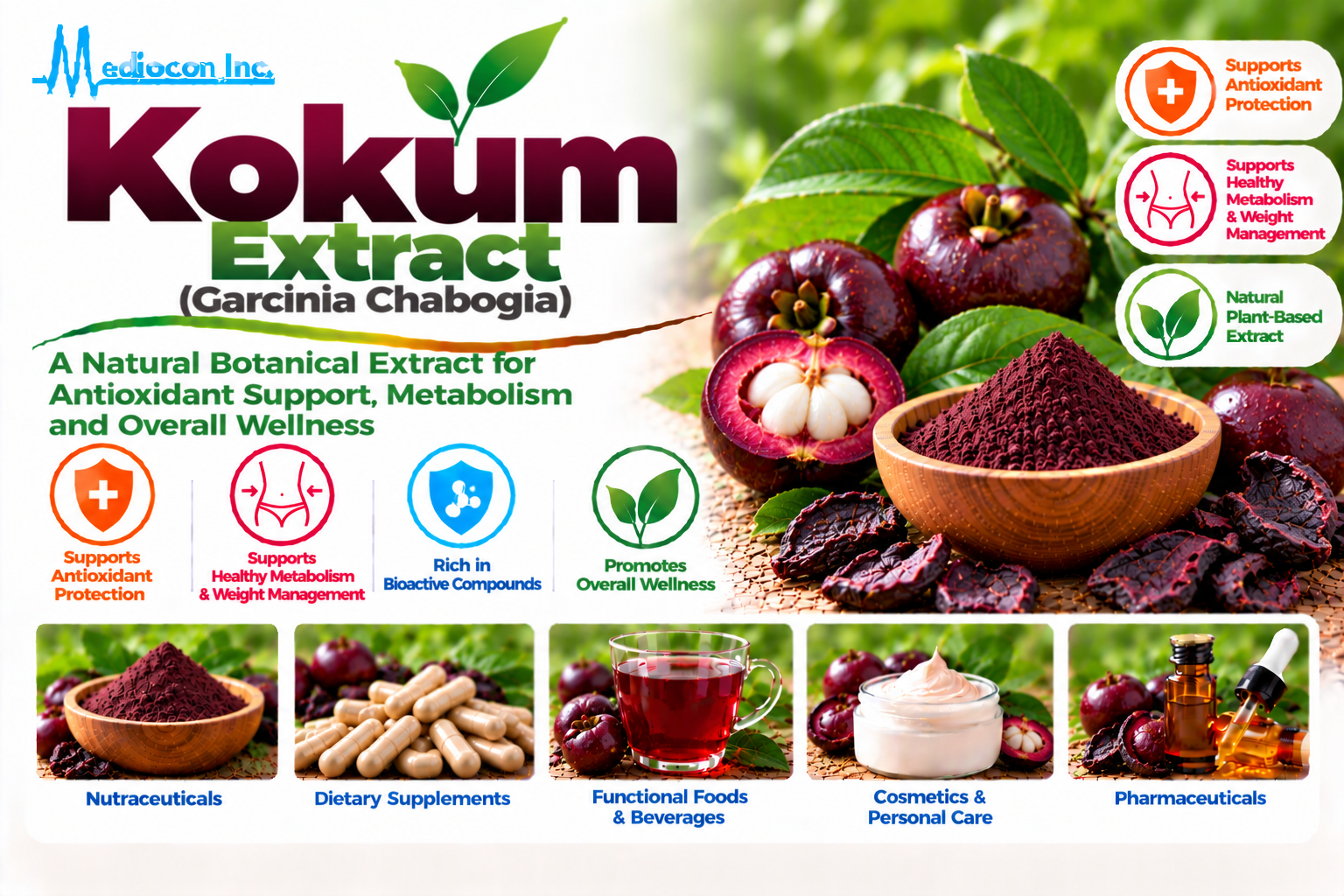
Kokum Extract is a botanical ingredient derived from Garcinia indica, a tropical plant belonging to the Clusiaceae family. Commonly known as kokum, the plant is traditionally associated with western India, particularly the Konkan region. Its dark purple fruits are used in regional culinary preparations and are valued for their characteristic sour flavor and naturally occurring plant constituents.
Kokum-derived ingredients may be considered for food development, beverage formulation, botanical research, and other suitable applications depending on the plant part, extraction method, product grade, and applicable regulations.
The composition of Kokum Extract varies according to the plant material and manufacturing process. Fruit-rind extracts, seed-derived materials, and other preparations should be treated as distinct ingredients because they can have different chemical and physical characteristics.
For manufacturers, researchers, and ingredient buyers, confirming botanical identity, product form, extraction ratio, and quality specifications is essential before selecting Kokum Extract for a commercial application.
Kokum Extract is a concentrated botanical preparation obtained from selected material of Garcinia indica. Depending on the intended application, the raw material may be processed using a suitable extraction method to obtain an extract containing selected naturally occurring constituents.
The fruit rind is associated with the characteristic color and sour taste of kokum. Kokum also contains naturally occurring organic acids and other plant compounds. The composition of a finished extract depends on the raw material, extraction solvent, processing conditions, and concentration method.
Commercial products may be available as powders, liquids, concentrates, or other specified forms. These forms are not automatically interchangeable because their composition, solubility, and intended applications can differ.
Before selecting a product, buyers should confirm the botanical species, plant part, extraction process, product form, and any specified marker compounds.
Accurate botanical identification is important in the botanical ingredient industry because similar common names can refer to different species.
Kokum is particularly associated with western India's coastal regions. The fruit is used in regional cuisine, and its rind is valued for its characteristic sourness and color.
Kokum should not be confused with Garcinia gummi-gutta, a different species often associated with products marketed as Garcinia cambogia. Botanical identity must be confirmed using the actual product documentation.
The chemical composition of kokum depends on the plant part and extraction process. The following constituents are relevant to understanding the botanical material, but their presence and concentration should not be assumed for every commercial extract.
Kokum fruit is known for its sour taste, which is associated with naturally occurring organic acids. These compounds contribute to its culinary characteristics and may be relevant when developing food ingredients.
The acid profile and concentration can vary according to fruit maturity, processing, and the final product form.
The dark-colored rind of kokum fruit contains naturally occurring pigments, including anthocyanins. These pigments contribute to the fruit's characteristic appearance.
Pigment concentration and stability can be affected by extraction conditions, temperature, light exposure, and storage. Product-specific testing is necessary when color characteristics are important to a formulation.
Polyphenols are a broad class of plant-derived compounds studied in many fruits and botanical materials. Kokum-derived materials have attracted interest for their phytochemical composition.
The concentration of individual polyphenols varies with the raw material and extraction method. A particular compound should only be claimed as present at a defined level when supported by analytical results.
Kokum contains a range of naturally occurring compounds that may vary across fruit rind, seeds, and other plant parts. Consequently, a fruit-rind extract should not be treated as chemically equivalent to a seed-derived product.
The product specification should identify the source material and describe any relevant analytical characteristics.
Kokum Extract may be evaluated for the following applications, subject to product grade, safety assessment, and regulatory requirements.
Kokum is traditionally used in regional food and beverage preparations. Suitable fruit-derived ingredients may be considered for products requiring a characteristic sour flavor or botanical fruit profile.
Formulation suitability depends on acidity, color, flavor intensity, solubility, and stability. Food-grade status and permitted use must be verified for the specific ingredient.
Kokum-derived materials may be assessed during the development of flavor systems and specialty food ingredients. Manufacturers should evaluate compatibility with other ingredients and the effect of processing conditions on the finished product.
The selected extract should have a defined specification appropriate to the intended application.
Kokum extracts may be used in research investigating botanical identity, phytochemical composition, extraction efficiency, and the stability of naturally occurring compounds.
Research results should be interpreted according to the plant part, preparation, analytical method, and experimental conditions.
Selected kokum-derived ingredients may be investigated for potential use in suitable cosmetic formulations. Before use, the ingredient should be evaluated for purity, stability, compatibility, and safety for its intended route of application.
Cosmetic suitability and any product claims must comply with applicable regulations.
For ingredient manufacturers and commercial buyers, Kokum Extract may be considered when its documented properties meet a specific formulation requirement.
Purchasing decisions should be based on the verified botanical source, extraction process, product grade, quality documentation, and applicable standards rather than the common name alone.
The manufacturing process depends on the plant part and the constituents the manufacturer intends to recover.
The selected plant material should be identified as Garcinia indica and assessed for quality, condition, and suitability. Traceability records can help confirm the origin and batch of the raw material.
The material may be cleaned and prepared before extraction. The preparation process depends on whether the starting material is fruit rind, seed, or another plant part.
A suitable extraction medium is selected according to the desired product profile and intended application. Different solvents recover different groups of constituents, so extracts prepared using different methods may have different compositions.
The extract is separated from the remaining plant material and may be concentrated under controlled conditions. Processing parameters can influence the retention and stability of selected compounds.
Where a powder is required, the concentrated extract may be dried using an appropriate process. Liquid products may undergo further concentration or clarification.
The finished product should be assessed against the approved specification.
Testing may include botanical identification, physical characteristics, relevant assay methods, moisture, contaminants, and microbiological parameters as appropriate.
Packaging and storage conditions should be selected according to the product's stability requirements.
Quality requirements depend on the product form and intended application. A technical specification may cover:
Not every test applies to every extract. Numerical limits should be established from the approved specification and verified using the relevant Certificate of Analysis.
Before purchasing Kokum Extract, buyers should:
Botanical origin alone does not establish that an extract is suitable for every application. Safety depends on the plant species, plant part, concentration, manufacturing process, impurities, and intended exposure.
Research involving one Garcinia species or a particular preparation should not automatically be applied to another species or commercial extract. Medical or weight-management claims should not be made without appropriate evidence and regulatory authorization.
Manufacturers should verify the relevant safety and labeling requirements before incorporating Kokum Extract into a finished product.
Kokum Extract, when derived from Garcinia indica, is a botanical ingredient associated with the fruit's characteristic sourness, color, and naturally occurring plant constituents. Potential applications include food and beverage development, botanical research, and selected ingredient-formulation activities, depending on the grade and regulatory suitability.
Reliable product selection requires confirmation of botanical identity, plant part, extraction method, technical specifications, and batch quality. Fruit-rind extract and seed-derived materials should be evaluated separately, and Kokum should not be confused with Garcinia gummi-gutta.
Mediocon Inc. product information should reflect verified specifications, current product availability, and appropriate documentation so that customers can make informed ingredient-selection decisions.
| Parameter | Specification |
|---|---|
| Identification | Botanical identity |
Mediocon Inc is a GMP-certified API manufacturer and bulk pharmaceutical ingredient supplier based in Aurangabad, Maharashtra, India. We specialise in supplying Kokum Extract (Garcinia indica) Manufacturer in India | Mediocon INC. and over 1,000 other Active Pharmaceutical Ingredients, excipients, herbal extracts, and nutraceutical ingredients to pharmaceutical manufacturers worldwide.
Our Kokum Extract (Garcinia indica) Manufacturer in India | Mediocon INC. is manufactured under strict quality management protocols compliant with WHO-GMP, ISO 9001:2015, and major pharmacopoeial standards (IP, BP, USP, EP). Every batch undergoes full analytical testing before release with a Certificate of Analysis.
Export Markets
Quality & Compliance