
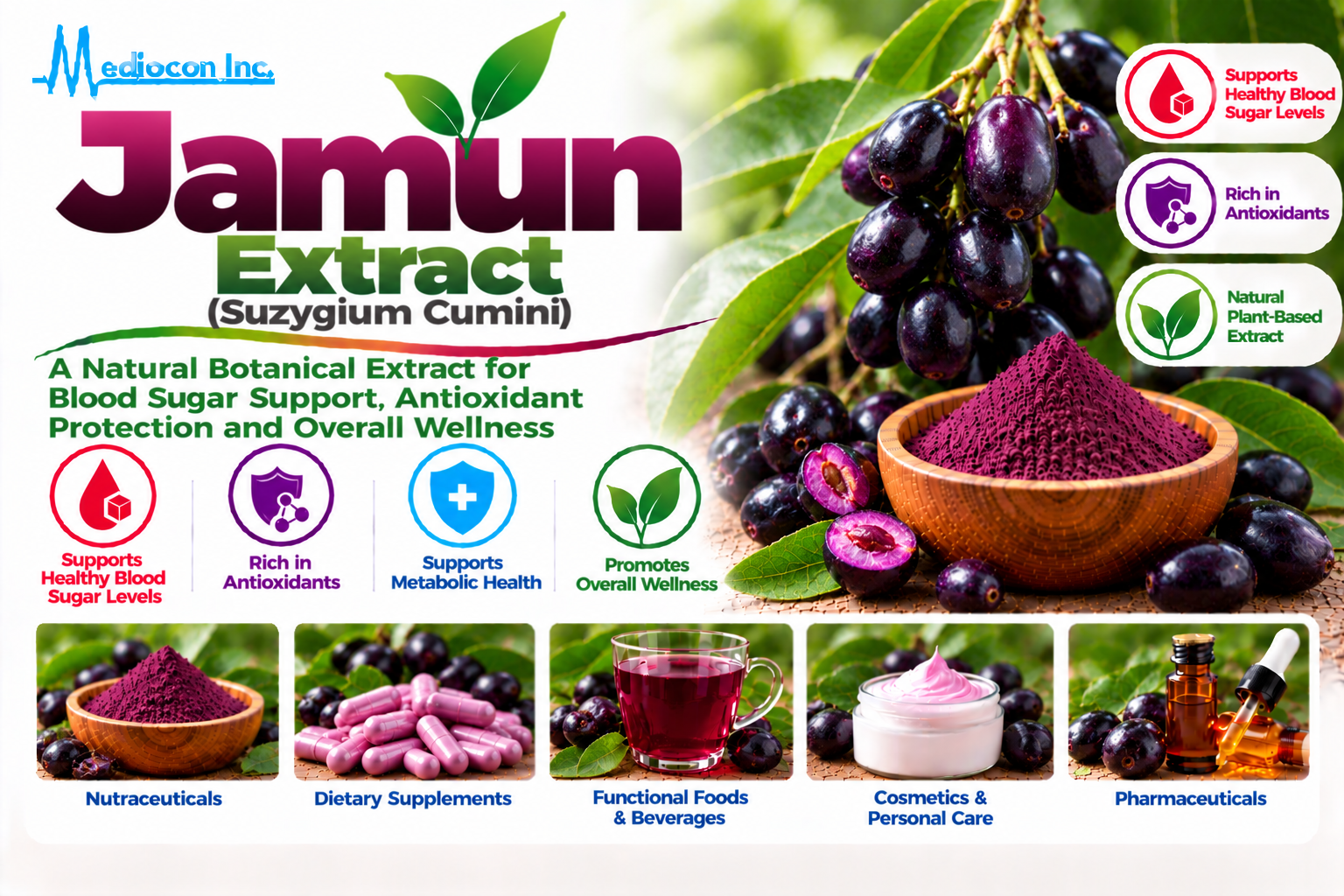
Jamun Extract is a botanical ingredient derived from Syzygium cumini, a tropical plant belonging to the Myrtaceae family. Commonly known as Jamun, Java plum, or Indian blackberry, the plant is widely recognized for its dark purple fruits and its history of use in traditional botanical practices. Different parts of the plant, including the fruit, seeds, leaves, and bark, contain naturally occurring compounds that have attracted interest in botanical research and ingredient development.
With growing interest in plant-derived ingredients, Jamun Extract is relevant to manufacturers, researchers, and businesses exploring botanical raw materials for suitable food, nutraceutical, cosmetic, and research applications. However, the properties and composition of an extract depend on the plant part used, the extraction method, the concentration process, and any standardization requirements.
At Mediocon Inc., product information for Jamun Extract should be based on the specific grade and verified technical documentation. Understanding its botanical identity, chemical composition, processing considerations, and quality parameters is important when evaluating it for commercial or formulation purposes.
Jamun Extract is produced by processing selected plant material from Syzygium cumini to obtain a concentrated preparation containing some of the constituents present in the original material. Depending on the manufacturing process, the final ingredient may be supplied as a powder, liquid extract, or another specified form.
The extraction process generally involves preparing the selected plant material, extracting soluble constituents using an appropriate solvent, separating unwanted plant material, and concentrating or drying the extract when required. The final product may then undergo testing to assess identity, quality, purity, and other specification requirements.
Jamun Extract is not a single standardized substance with an identical composition across all products. A fruit extract may have a different chemical profile from a seed extract, while leaf and bark extracts may contain different proportions of naturally occurring constituents.
For this reason, buyers should confirm the plant part, extraction ratio, solvent system, standardization marker, and intended application before selecting a Jamun Extract grade.
The botanical name of Jamun is Syzygium cumini (L.) Skeels. Accurate botanical identification is essential in the botanical ingredient industry because common names can vary across regions and may refer to different plants.
Botanical classification
The fruit is typically dark purple to nearly black when ripe, while the seeds are enclosed within the fruit. Leaves, bark, and other plant parts are also used in various traditional contexts and scientific investigations.
When purchasing or developing a product containing Jamun Extract, the botanical name should be included in the product specification. The plant part should also be explicitly identified so that the ingredient can be evaluated according to its intended purpose.
The plant part used to manufacture an extract is one of the most important factors affecting its composition and application.
Jamun fruit extract is prepared from the fruit of Syzygium cumini. The fruit contains naturally occurring pigments and other plant constituents, including polyphenolic compounds. Its composition can vary depending on fruit maturity, growing conditions, processing, and extraction methods.
Fruit-derived ingredients may be considered for suitable food, beverage, or nutraceutical formulations, depending on the grade, applicable regulations, and product-specific safety requirements.
The color and composition of fruit extracts may vary according to the processing conditions and concentration of naturally occurring constituents. A manufacturer should therefore provide appropriate product documentation rather than relying on color alone to establish quality.
Jamun seed extract is produced from the seeds of the fruit. Seeds have a different chemical composition from the fruit pulp and are frequently discussed separately in botanical and phytochemical research.
Seed-derived extracts may contain different proportions of polyphenols, tannins, and other naturally occurring compounds. Their composition depends on the extraction procedure and the specifications established for the finished ingredient.
For commercial use, Jamun Seed Extract should be evaluated using its own technical specification. It should not automatically be considered equivalent to Jamun Fruit Extract.
Jamun leaf extract is obtained from the leaves of Syzygium cumini. Leaves contain their own mixture of plant constituents, which can differ from those found in the fruit and seeds.
The properties of leaf extract depend on the age and condition of the leaves, the processing method, and the extraction solvent. Its suitability for a particular application must be determined through product-specific testing and applicable regulatory review.
Bark-derived extract is another distinct botanical preparation. The bark may have a different chemical profile from the fruit, seeds, and leaves, so it requires separate identification and quality documentation.
The plant part must be clearly recorded in purchasing specifications, manufacturing records, and product descriptions to reduce the risk of ingredient substitution or incorrect labeling.
Research on Syzygium cumini has examined a range of naturally occurring plant compounds. The exact compounds and their concentrations in a commercial extract depend on the source material and manufacturing process.
Polyphenols are a broad group of plant-derived compounds found in many fruits, seeds, leaves, and other botanical materials. Some polyphenols have been investigated for their antioxidant activity in laboratory studies.
Their presence and concentration in Jamun Extract should be confirmed through appropriate analytical testing when a particular polyphenol profile is important to the intended application.
Tannins are naturally occurring plant compounds that can be found in different parts of Syzygium cumini. Their concentration may differ between fruit, seeds, leaves, and bark.
Tannin content can influence the sensory and chemical characteristics of an extract, including astringency in relevant preparations. The actual content should be measured when required by a product specification.
Jamun fruit is known for its deep purple coloration. This color is associated with naturally occurring pigments, including anthocyanins in the fruit.
The amount of these pigments can vary with maturity, processing, storage, and extraction conditions. Fruit pigment characteristics should not be assumed to apply to seed or leaf extracts.
Flavonoids and other phytochemicals have been investigated in various parts of Syzygium cumini. Their presence and concentration depend on the plant material and analytical method used.
A general botanical description cannot establish the composition of every commercial extract. Product-specific analytical results are needed when a formulation requires a defined compound or concentration.
Jamun Extract may be considered for a range of applications, subject to the plant part, product grade, safety assessment, and applicable local regulations.
Selected Jamun-derived ingredients may be evaluated for use in nutraceutical or botanical formulations. The suitability of a specific extract depends on its composition, quality documentation, permitted use, and intended market.
Product developers should review ingredient identity, contaminants, dosage-form compatibility, and relevant regulatory requirements before including it in a finished product.
No specific health outcome should be assumed solely because an ingredient is plant-derived or has a history of traditional use.
Certain grades of Jamun fruit-derived ingredients may be considered for food and beverage development where their use is permitted. Factors such as color, flavor, solubility, stability, and compatibility with other ingredients may affect their suitability.
Food applications require confirmation that the extract meets the relevant food-grade requirements. A botanical extract intended for research or another industrial application should not automatically be considered suitable for food use.
Plant-derived ingredients are sometimes evaluated during the development of cosmetic and personal care products. A Jamun-derived ingredient may be considered for research into formulation properties, appearance, or other suitable cosmetic applications.
Before use in a cosmetic formulation, developers should evaluate the ingredient's identity, purity, compatibility, stability, and safety for the intended route of application. Cosmetic claims must also comply with the applicable regulations.
Jamun Extract may be used in laboratory research focused on botanical composition, extraction methods, phytochemical analysis, and ingredient characterization.
Researchers may compare different plant parts or extraction conditions to understand how they influence the resulting chemical profile. Such work can help establish specifications for future product development.
For manufacturers and ingredient buyers, Jamun Extract selection involves more than the botanical name. The product must meet the technical requirements of the intended application, including consistency between batches, suitable packaging, traceability, and appropriate documentation.
Commercial buyers should confirm the product grade and request a current technical data sheet and Certificate of Analysis before approving an ingredient for production.
The quality of a botanical extract is influenced by several factors throughout the supply chain.
Correct identification of Syzygium cumini is fundamental to product quality. The selected plant part should be documented, and raw materials should be assessed for authenticity and suitability before processing.
Geographic origin, harvesting practices, maturity, drying, and storage can affect the characteristics of the starting material.
The extraction method influences which constituents are recovered and in what proportions. Solvent selection, temperature, extraction time, and processing conditions can all affect the final product.
Different extraction methods may produce ingredients with different colors, solubility profiles, and phytochemical compositions. As a result, two products carrying the same general name may not be interchangeable.
An extraction ratio describes the relationship between the starting botanical material and the resulting extract according to the manufacturer's defined calculation. Its interpretation depends on the manufacturing process and the way the ratio is reported.
Standardization refers to controlling a specified constituent or analytical characteristic within a defined range. Not every Jamun Extract is standardized to the same marker, and an extraction ratio does not by itself establish the concentration of an active or marker compound.
Buyers should confirm both parameters where they are relevant to the intended application.
Moisture content can affect the physical stability and storage behavior of powdered botanical extracts. Packaging and storage conditions should be selected according to the characteristics of the product.
The recommended temperature, humidity conditions, shelf life, and storage instructions should be obtained from the product-specific documentation rather than assumed to be identical for all grades.
Depending on the intended application, a quality-control program may include testing for heavy metals, microbial contamination, residual solvents, pesticide residues, or other relevant contaminants.
Testing requirements should be determined by the product specification, the extraction process, and the applicable regulations. The test methods and acceptance limits should be documented and appropriate to the actual grade.
Reliable technical documentation helps buyers evaluate a botanical ingredient and determine whether it meets their requirements.
A product-specific Certificate of Analysis may include the following information, where applicable:
Not every test applies to every product. The final specification should be tailored to the extract and its intended application.
For example, a fruit extract intended for a color-related food application may require different characterization from a seed extract being assessed for a research formulation. Quality requirements should be established before commercial approval.
When evaluating Jamun Extract for a formulation, developers should consider its physical and chemical characteristics alongside the requirements of the finished product.
The solubility of an extract depends on its composition, solvent history, and processing method. A product that disperses well in one formulation may behave differently in another.
Small-scale compatibility testing can help determine whether the ingredient is appropriate for the intended formulation. Any solubility claim should be supported by the technical specification or testing data.
Jamun fruit-derived ingredients may exhibit coloration associated with naturally occurring pigments. However, color varies with the plant part, concentration, processing, and storage conditions.
Appearance can be useful for routine batch comparison, but it should not be used as the only indicator of identity or purity.
Consistency is important when an extract is used in repeat manufacturing. Buyers should compare specifications and analytical results across batches to establish whether the material meets their defined requirements.
Where a particular marker compound is important, the marker and its acceptable range should be explicitly stated in the purchase specification.
The regulatory status of an ingredient can depend on its plant part, preparation, intended use, market, and product claims. An ingredient acceptable for one application may not automatically be permitted for another.
Manufacturers should confirm applicable regulations and labeling requirements before incorporating Jamun Extract into a commercial product.
A botanical origin does not automatically guarantee that an ingredient is safe for every person or every application. Safety depends on the plant part, extraction process, concentration, impurities, intended exposure, and quality of the finished material.
Research findings relating to raw Jamun fruit or a specific extract should not be automatically applied to every commercially available Jamun Extract. Similarly, laboratory findings do not establish that a product prevents, treats, or cures a disease.
For food, nutraceutical, cosmetic, or other regulated applications, manufacturers should conduct the appropriate safety and regulatory assessment and use only grades supported by relevant documentation.
Consumers should not use concentrated botanical extracts as substitutes for prescribed medical treatment. Any health-related product claims should be supported by appropriate evidence and comply with applicable regulations.
Selecting a reliable source for Jamun Extract requires careful evaluation of product identity, quality systems, and documentation.
Confirm that the material is identified as Syzygium cumini and that the plant part matches the intended application.
Obtain a technical data sheet describing the product form, extraction ratio, standardization, physical properties, and applicable quality parameters.
Check the batch-specific CoA for identity, assay results where relevant, and required purity or contaminant tests. Confirm that the reported methods and limits match the purchasing specification.
Ensure that the grade is suitable for the intended application and that the relevant regulatory and safety requirements are satisfied.
Review batch identification, packaging information, storage instructions, and traceability documentation. These details support inventory control and quality management.
Before placing an order, confirm current availability, quantity options, packaging, lead time, pricing, and any applicable documentation with the vendor.
Accurate product information supports better purchasing decisions, consistent formulation, and responsible product marketing. For botanical extracts, the botanical name alone is not enough to define a commercial ingredient.
Jamun Extract should be described using the actual plant part, product form, extraction process, and standardization information where applicable. This approach helps distinguish fruit, seed, leaf, and bark extracts and reduces the risk of using an unsuitable grade.
For Mediocon Inc., publishing verified specifications and clear product descriptions can help customers understand the available ingredient and identify the documentation they need before making a purchasing decision.
Product availability, manufacturing status, and specific technical values should be confirmed directly against current company records before they are presented as established facts.
Jamun Extract, derived from Syzygium cumini, is a botanical ingredient of interest in botanical research and suitable ingredient-development applications. Its characteristics depend on the plant part, extraction method, and degree of standardization. Fruit, seed, leaf, and bark extracts should be evaluated separately rather than treated as identical materials.
For manufacturers, researchers, and ingredient buyers, the most important considerations include botanical identity, product-specific specifications, extraction details, quality testing, traceability, and regulatory suitability. Reviewing the technical data sheet and Certificate of Analysis helps establish whether a particular grade meets the intended requirements.
Mediocon Inc. can use clear, accurate product information to help customers evaluate Jamun Extract and request the technical documentation relevant to their application.
Mediocon Inc is a GMP-certified API manufacturer and bulk pharmaceutical ingredient supplier based in Aurangabad, Maharashtra, India. We specialise in supplying Jamun Extract (Syzygium cumini) Manufacturer in India | Mediocon Inc. and over 1,000 other Active Pharmaceutical Ingredients, excipients, herbal extracts, and nutraceutical ingredients to pharmaceutical manufacturers worldwide.
Our Jamun Extract (Syzygium cumini) Manufacturer in India | Mediocon Inc. is manufactured under strict quality management protocols compliant with WHO-GMP, ISO 9001:2015, and major pharmacopoeial standards (IP, BP, USP, EP). Every batch undergoes full analytical testing before release with a Certificate of Analysis.
Export Markets
Quality & Compliance