
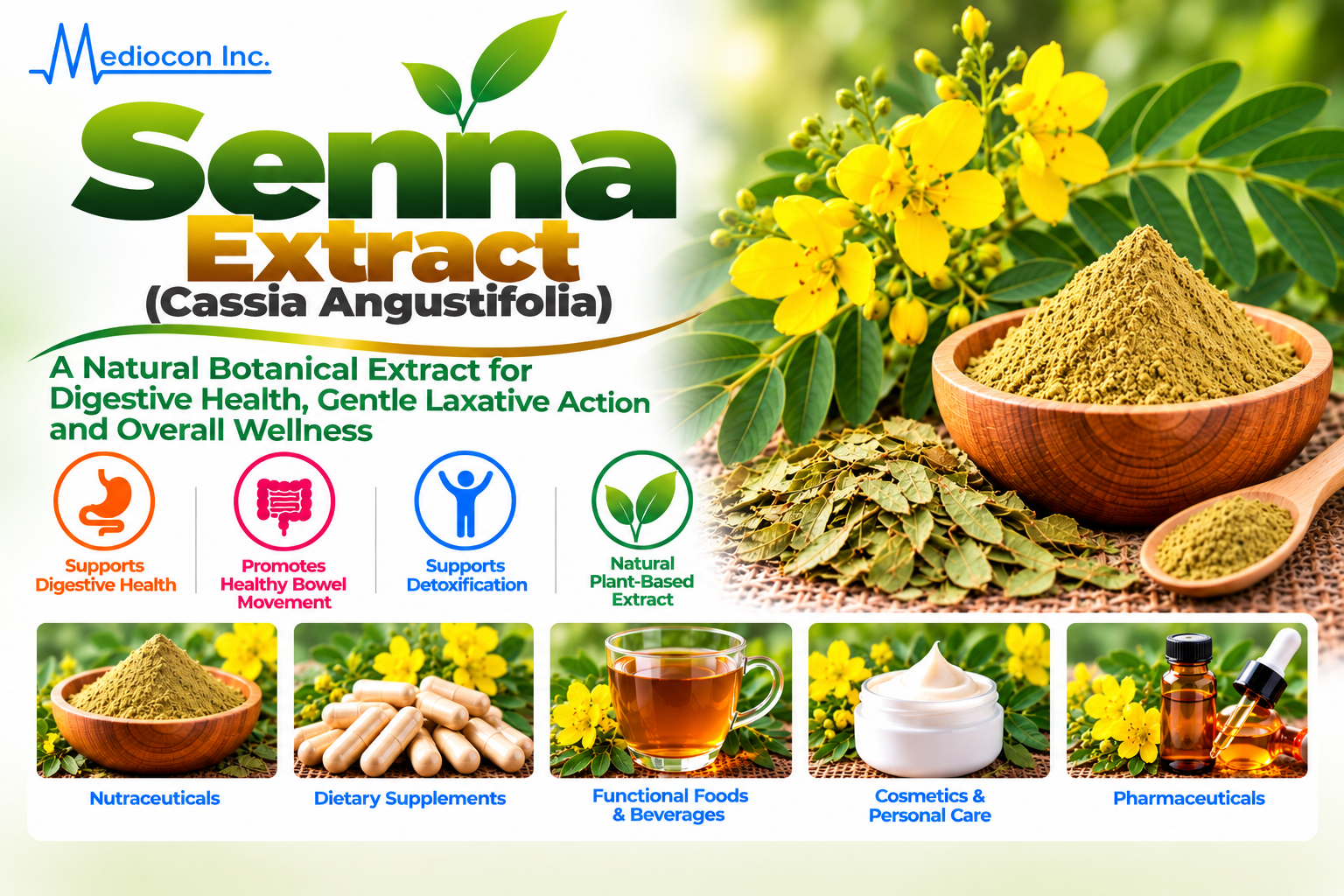
Senna (Cassia angustifolia), commonly known as Indian Senna, is a botanical plant belonging to the Fabaceae family. The leaves and pods are valued as sources of naturally occurring compounds known as sennosides. Senna-derived ingredients are used in regulated pharmaceutical and botanical applications, depending on the material's identity, composition, quality, and applicable regulations.
Mediocon Inc. provides product information for businesses evaluating Senna as a botanical raw material or extract. Buyers should confirm the exact product form, plant part, grade, and analytical specifications before selecting the ingredient for manufacturing or formulation development.
Botanical nomenclature may vary across supplier records and reference standards. Buyers should confirm the accepted botanical identity and the plant part stated in the product's technical documentation.
Senna extract is produced by processing selected senna plant material to obtain a preparation containing constituents of interest. The final composition depends on the plant part, source material, extraction process, solvent system, and any subsequent concentration or drying steps.
Senna leaf, senna pod, dried plant material, powder, and concentrated extract are distinct product forms. Their composition and concentration may differ substantially. An extract should not be assumed to have a particular sennoside concentration unless that value is supported by the product's specification and certificate of analysis (CoA).
Senna contains naturally occurring anthraquinone glycosides, including sennosides. These compounds are associated with senna's stimulant laxative activity. Their concentrations can vary with botanical source, plant part, harvesting, processing, and extraction conditions.
The following details should be confirmed for the exact commercial grade:
A standardization percentage should only be published when supported by current technical documentation.
Subject to grade, intended use, and applicable regulations, Senna-derived ingredients may be evaluated for:
Senna has pharmacological effects and specific safety considerations. Its intended use must be assessed against applicable product regulations, safety requirements, and labeling rules. It should not be presented as a general-purpose food, everyday wellness ingredient, or treatment for a medical condition without appropriate regulatory and evidentiary support.
Senna-related commercial materials may include:
Senna Leaves: Dried leaves used as botanical raw material.
Senna Pods: Dried pods used as a distinct botanical material.
Senna Powder: Powdered plant material whose composition depends on the plant part and processing.
Senna Extract: A preparation obtained by extracting selected constituents from senna material. The extract ratio, solvent, assay, and physical form must be confirmed.
These forms are not interchangeable. Select the form that matches the intended application and the technical requirements of the final product.
Quality evaluation should begin with confirmation of botanical identity and plant part. Depending on the intended use, the product may require tests for identity, assay, moisture, foreign matter, microbiological quality, heavy metals, pesticide residues, and residual solvents.
For pharmaceutical applications, additional requirements may apply, such as compliance with a specific pharmacopeial monograph, validated analytical methods, traceability, and manufacturing controls. Do not claim pharmacopeial compliance, a particular grade, or a specific certification unless it is documented for the actual product.
Packaging and pack sizes should be confirmed with the supplier. Store the material according to the product label and technical data sheet, protecting it from excess moisture, contamination, direct sunlight, and unsuitable temperatures. Keep containers properly closed and observe the stated shelf life.
Handle the product in accordance with its safety documentation and applicable workplace requirements. For products intended for pharmaceutical use, maintain appropriate traceability and quality records.
Mediocon Inc. provides product information to support businesses evaluating botanical ingredients and related raw materials. Buyers interested in Senna should request confirmation of the botanical identity, plant part, available form, grade, sennoside assay, analytical method, packaging, and relevant technical documentation.
The exact suitability of the material depends on its specifications and the requirements of the intended application.
Mediocon Inc is a GMP-certified API manufacturer and bulk pharmaceutical ingredient supplier based in Aurangabad, Maharashtra, India. We specialise in supplying Senna (Cassia angustifolia) and over 1,000 other Active Pharmaceutical Ingredients, excipients, herbal extracts, and nutraceutical ingredients to pharmaceutical manufacturers worldwide.
Our Senna (Cassia angustifolia) is manufactured under strict quality management protocols compliant with WHO-GMP, ISO 9001:2015, and major pharmacopoeial standards (IP, BP, USP, EP). Every batch undergoes full analytical testing before release with a Certificate of Analysis.
Export Markets
Quality & Compliance